
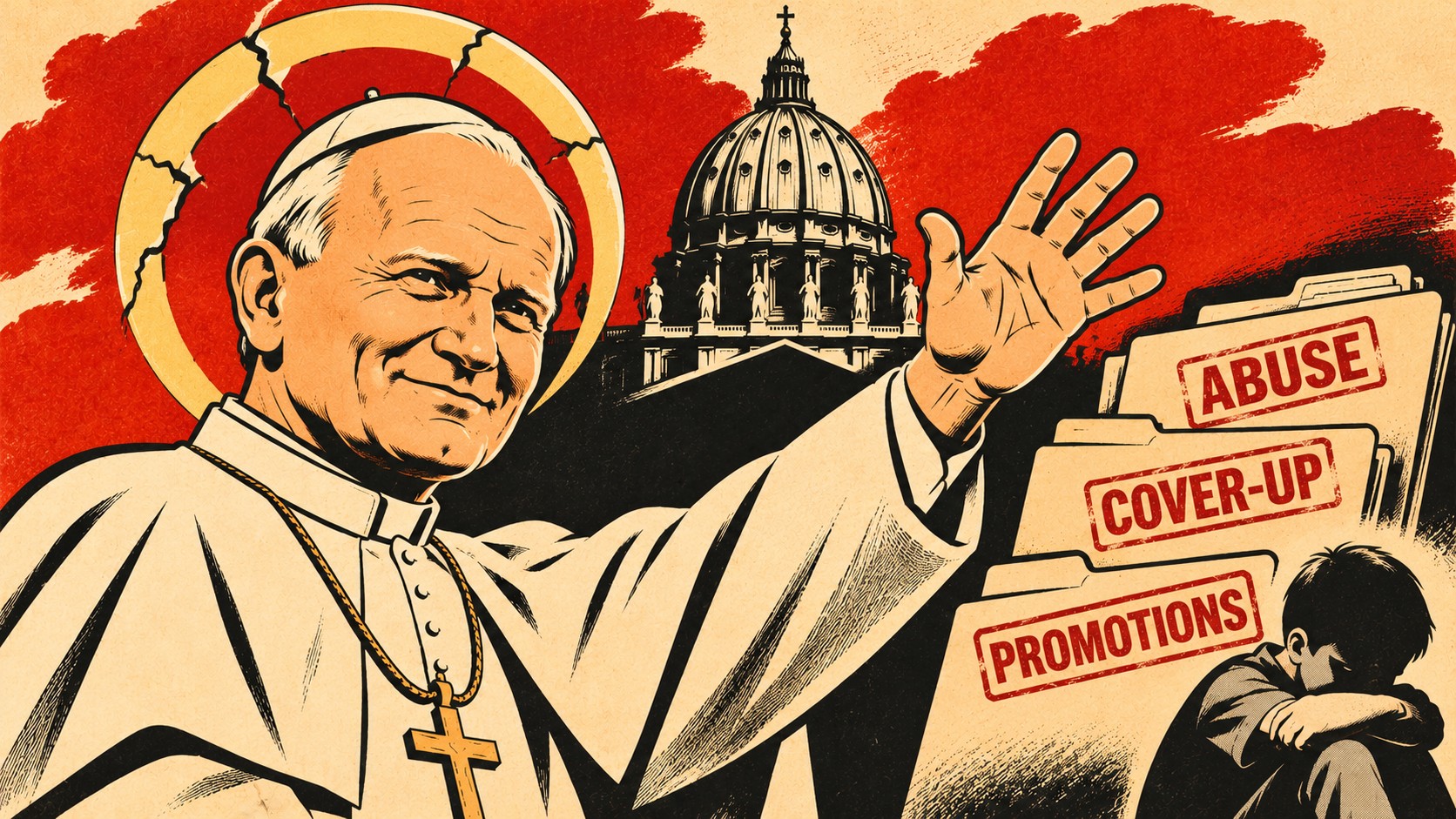
In April 2014, the Catholic Church declared Pope John Paul II a saint. Hundreds of thousands gathered in Rome to celebrate a man the Church presented as an extraordinary example of holiness, virtue, and devotion to God.
There was an enormous problem with that celebration.
John Paul II had presided over an institution engulfed in child sexual abuse scandals. He had promoted a cleric despite serious warnings about sexual misconduct. He had publicly celebrated another priest who would later be exposed as a serial child abuser. And he had provided a prestigious Vatican position to a cardinal whose handling of abusive priests helped ignite the American Catholic Church’s greatest modern scandal.
The Catholic Church canonized a man whose record included catastrophic failures to protect vulnerable people from sexual predators.
This is not an accusation built on speculation or anti-Catholic conspiracy theories. The most damning evidence comes from the Vatican itself.
The Church’s 2020 investigation into Theodore McCarrick documented John Paul II’s personal involvement in promoting him despite warnings. Its 2010 investigation into Marcial Maciel acknowledged serious crimes and an institutional culture that helped shield him.
The picture that emerges is of a powerful religious leader whose judgment repeatedly favored trusted, influential clergy when the consequences of getting those judgments wrong were potentially devastating.
John Paul II Was Warned About Theodore McCarrick
Theodore McCarrick spent decades climbing the Catholic hierarchy.
Under John Paul II, he became Bishop of Metuchen in 1981, Archbishop of Newark in 1986, Archbishop of Washington in 2000, and a cardinal in 2001.
By the time of his appointment to Washington, serious concerns about his conduct had already reached senior Church officials.
The Vatican’s 2020 McCarrick Report documented allegations that McCarrick had shared beds with seminarians and young adult men. Anonymous letters in the early 1990s had also accused him of abusing minors.
On October 28, 1999, Cardinal John O’Connor of New York sent a warning to the Vatican’s representative in the United States.
O’Connor expressed concern about promoting McCarrick because of allegations involving his conduct with seminarians and other young men.
The warning reached John Paul II.
The Vatican initially investigated and decided that promoting McCarrick would be imprudent. Three of four bishops consulted during the inquiry provided information that the Vatican’s later investigation found inaccurate or incomplete.
But even with that flawed inquiry, the concerns were serious enough that McCarrick was initially excluded from consideration for Washington.
Then McCarrick intervened.
In August 2000, he wrote to Stanisław Dziwisz, John Paul II’s personal secretary, emphatically denying sexual misconduct.
The pope believed him.
According to the Vatican’s investigation, John Paul II became convinced by McCarrick’s denial and personally directed officials to reconsider him.
On November 21, 2000, McCarrick was appointed Archbishop of Washington.
Three months later, John Paul II made him a cardinal.
The pope had received warnings serious enough to derail a promotion. He ultimately chose to trust the accused cleric and elevate him anyway.
That was a decision made at the very top of the Catholic Church.
The Vatican Eventually Found McCarrick Guilty of Sexual Abuse
In February 2019, the Vatican announced that its disciplinary proceedings had found McCarrick guilty of sexual misconduct involving minors and adults, aggravated by abuse of power, as well as solicitation during confession.
He was dismissed from the priesthood.
The man John Paul II elevated to one of Catholicism’s most prestigious positions had been found guilty under canon law of grave sexual offenses.
The Vatican’s 2020 report established that John Paul II personally made the Washington appointment. It also documented the incomplete information supplied by other bishops and McCarrick’s forceful denial.
The pope did not have a substantiated, direct victim complaint about child abuse before him in 2000. But he had enough warning signs to justify a far more rigorous investigation before entrusting McCarrick with additional authority.
That distinction makes the failure clearer, not less important.
Protecting vulnerable people requires acting responsibly on credible warnings before further harm occurs. It should not require waiting until a respected cleric’s misconduct becomes impossible to deny.
John Paul II had extraordinary resources, international authority, and the power to demand independent scrutiny.
Instead, his confidence in McCarrick helped determine the outcome.
The consequence was not simply that a dangerous man remained in the Church. He received greater authority, prestige, and credibility from the pope himself.
Marcial Maciel: Another Predator With Powerful Friends
If McCarrick were the only case, it would already represent a devastating failure of papal judgment.
But Marcial Maciel makes the historical record considerably more disturbing.
Maciel founded the Legionaries of Christ, a Catholic religious order that became influential through its schools, seminaries, wealthy supporters, and reputation for strict religious devotion.
He was also a serial sexual abuser.
Former Legionaries accused Maciel of abusing them when they were children and teenagers. Their allegations became public through investigative reporting in 1997.
The Vatican’s Congregation for the Doctrine of the Faith received formal accusations against Maciel beginning in 1998.
Yet Maciel continued enjoying extraordinary religious prestige.
John Paul II repeatedly supported the Legionaries and publicly honored their founder.
On November 30, 2004, the pope addressed members of the organization during celebrations marking the 60th anniversary of Maciel’s priestly ordination.
He praised the religious community and offered Maciel his personal good wishes and blessing.
This occurred years after serious allegations against Maciel had become public and reached Vatican authorities.
The contrast is grotesque.
Men who accused a powerful priest of abusing them had spent years seeking accountability. The pope was publicly celebrating that priest’s religious accomplishments.
In 2006, under Pope Benedict XVI, the Vatican finally restricted Maciel’s public ministry.
Four years later, a Vatican investigation issued a devastating assessment.
It concluded that Maciel had committed grave misconduct, including actual crimes, and described how he had cultivated trust, silence, and institutional protection.
The Vatican acknowledged that people who questioned Maciel’s conduct had sometimes been discredited or pushed aside.
A 2019 report by the Legionaries of Christ identified at least 60 minors sexually abused by Maciel.
John Paul II had celebrated a man whose religious organization eventually acknowledged that he had sexually abused dozens of children.
The accusations had been available for years. The pope’s public support continued.
And the survivors were left confronting an institution that treated their alleged abuser as an admired spiritual leader.
The Church’s Own Investigation Described How Maciel Became Untouchable
The Vatican’s 2010 statement about Maciel is extraordinary because it reveals how institutional reputation can protect an abuser.
Investigators found that Maciel built relationships that generated loyalty and silence. His reputation and organizational achievements helped insulate him from scrutiny.
Those who raised doubts about his conduct were sometimes discredited. Concerns about damaging the Legionaries’ positive work contributed to the protection surrounding him.
That is a devastating indictment of religious institutional culture.
Maciel’s success in recruiting priests, attracting supporters, and expanding Catholic influence became part of the justification for trusting him.
His accomplishments helped create the aura of spiritual legitimacy that made allegations against him easier to dismiss.
This is precisely the problem with treating religious success as evidence of moral authority.
An effective fundraiser can be an abuser. A charismatic spiritual leader can be a predator. An organization can perform charitable work while protecting the man responsible for terrible crimes.
Good works do not erase sexual abuse. Religious prestige does not establish innocence. And institutional success is no substitute for investigating credible allegations.
Yet those distinctions were repeatedly lost in the Church’s treatment of Maciel.
Cardinal Bernard Law: Disgrace in Boston, Prestige in Rome
John Paul II’s handling of Cardinal Bernard Law provides another extraordinary example.
Law resigned as Archbishop of Boston in December 2002 after investigations exposed how abusive priests had been transferred and protected within the archdiocese.
The scandal became a defining moment in the public exposure of Catholic clergy sexual abuse.
Church records revealed that senior officials had allowed dangerous priests to continue serving despite serious complaints.
Law’s leadership was central to the resulting public outrage.
Then, in May 2004, John Paul II appointed him archpriest of the Basilica of St. Mary Major in Rome.
The position was largely ceremonial, but it was also prestigious and highly visible.
Consider the message.
A cardinal whose handling of child sexual abuse had contributed to a massive institutional scandal resigned in disgrace. Less than two years later, the pope gave him an honored position in one of Rome’s most important basilicas.
Survivors were demanding accountability.
The Vatican provided a soft landing.
The Catholic hierarchy appeared far more capable of finding comfortable positions for disgraced leaders than of delivering meaningful accountability to the people harmed under their supervision.
This was not a question of whether Law had personally committed sexual abuse. It was about the responsibility of leaders who failed to protect children from known dangers.
John Paul II’s appointment sent a profoundly disturbing message about how the institution treated those failures.
In 2002, John Paul II Was Still Defending the Church’s Reputation
One of the most revealing documents from John Paul II’s papacy is his April 23, 2002 address to American cardinals during the escalating clergy abuse crisis.
The pope acknowledged the seriousness of the abuse and expressed concern for victims.
But he also defended the broader institution against the reputational damage caused by the scandal.
He compared the Church to a great work of art whose beauty survives its blemishes.
That analogy is astonishing in the context of children being sexually abused by clergy.
The victims were not blemishes on an institutional masterpiece. They were human beings who had been sexually violated by men entrusted with their care.
The central moral question was not whether the Church’s reputation could survive.
It was why so many vulnerable people had been failed by an institution claiming exceptional moral authority.
John Paul II also emphasized the possibility of Christian conversion and the good accomplished by priests.
But the existence of admirable clergy and charitable accomplishments had no bearing on whether abusive priests should have been removed or whether responsible bishops should face consequences.
The Church’s reputation was not the victim.
The children were.
And Then the Catholic Church Made Him a Saint
On April 27, 2014, Pope Francis canonized John Paul II.
By then, the Boston abuse scandal was public knowledge. Maciel’s crimes had been acknowledged by the Vatican. Bernard Law’s controversial Roman appointment was part of the historical record.
The full McCarrick investigation would not be published until 2020, but the broader failures of Catholic leadership were already undeniable.
Yet John Paul II was elevated to sainthood.
The Catholic Church asks believers to regard canonized saints as examples of holiness and lives worthy of religious veneration.
That raises an unavoidable question.
What standard of extraordinary virtue allows a religious leader’s documented failures in protecting vulnerable people to coexist with his official elevation as a model of holiness?
The Church has its own theological criteria for canonization. But those criteria do not erase historical decisions or their consequences.
A declaration of sainthood cannot undo the promotion of McCarrick, the public celebration of Maciel, or the appointment of Bernard Law.
And it certainly cannot relieve a leader of responsibility for decisions made while exercising enormous institutional power.
Conclusion: Sainthood Cannot Erase a Disgraceful Record
John Paul II occupied one of the most powerful religious offices in the world for more than a quarter-century.
He had the authority to appoint bishops, elevate cardinals, demand investigations, and establish standards of accountability throughout the Catholic hierarchy.
That power came with extraordinary responsibility.
The Vatican’s own records show that he received warnings about Theodore McCarrick and nevertheless personally approved his promotion. He publicly honored Marcial Maciel while serious abuse allegations were already known to Church authorities. He gave Bernard Law a prestigious appointment after Boston’s clergy abuse scandal had exposed devastating leadership failures.
These were not minor administrative oversights. They were decisions involving men entrusted with authority over vulnerable people, made in the shadow of allegations and institutional failures with potentially catastrophic consequences.
John Paul II’s public image was built around holiness, courage, and moral certainty.
His record on clerical sexual abuse deserves a far harsher judgment.
A religious leader who exercises immense power cannot escape accountability by claiming sincere intentions, preserving institutional loyalty, or receiving a posthumous declaration of sainthood.
The people harmed by abusive clergy deserved protection, independent investigation, and justice. Their welfare should have mattered more than the careers of influential priests or the prestige of the Catholic hierarchy.
For too long, the Church’s powerful men received deference that their conduct had not earned.
John Paul II is remembered by the Catholic Church as a saint.
He should also be remembered as the pope who promoted Theodore McCarrick, celebrated Marcial Maciel, and provided Bernard Law with a prestigious appointment after his disgrace.
The title of saint does not cancel the historical record. And no institution can declare away the moral consequences of its leaders’ decisions.
References
- Holy See Secretariat of State (2020). Report on the Holy See’s Institutional Knowledge and Decision-Making Related to Former Cardinal Theodore Edgar McCarrick. Vatican investigation documenting allegations, internal warnings, incomplete inquiries, and John Paul II’s personal decision to appoint McCarrick to Washington.
- Vatican Congregation for the Doctrine of the Faith (2019). Press Release on Theodore McCarrick’s Dismissal From the Clerical State. Official findings concerning sexual misconduct involving minors and adults and abuse of power.
- Pope John Paul II (2004). Address to the Legionaries of Christ and the Regnum Christi Movement. The pope’s public address celebrating Marcial Maciel’s priestly anniversary.
- Holy See (2010). Communiqué Regarding the Apostolic Visitation of the Legionaries of Christ. Vatican findings acknowledging Maciel’s serious crimes and the mechanisms that protected him.
- Legionaries of Christ (2019). Report 1941–2019 on the Phenomenon of Sexual Abuse of Minors. Institutional report documenting sexual abuse within the order, including allegations involving its founder.
- Associated Press (2017). Cardinal Bernard Law, Central Figure in Abuse Scandal, Dies. Reporting on Boston’s abuse scandal and Law’s subsequent Vatican appointment.
- Pope John Paul II (2002). Address to the Cardinals of the United States. Papal response to the American clergy sexual abuse crisis.
- Holy See (2014). Canonization of John XXIII and John Paul II. Official record of John Paul II’s canonization on April 27, 2014.