Editor’s note: Because this article addresses contested internal management decisions in a sharply critical tone, we refer to the two executives at the center of the account by their first names only.
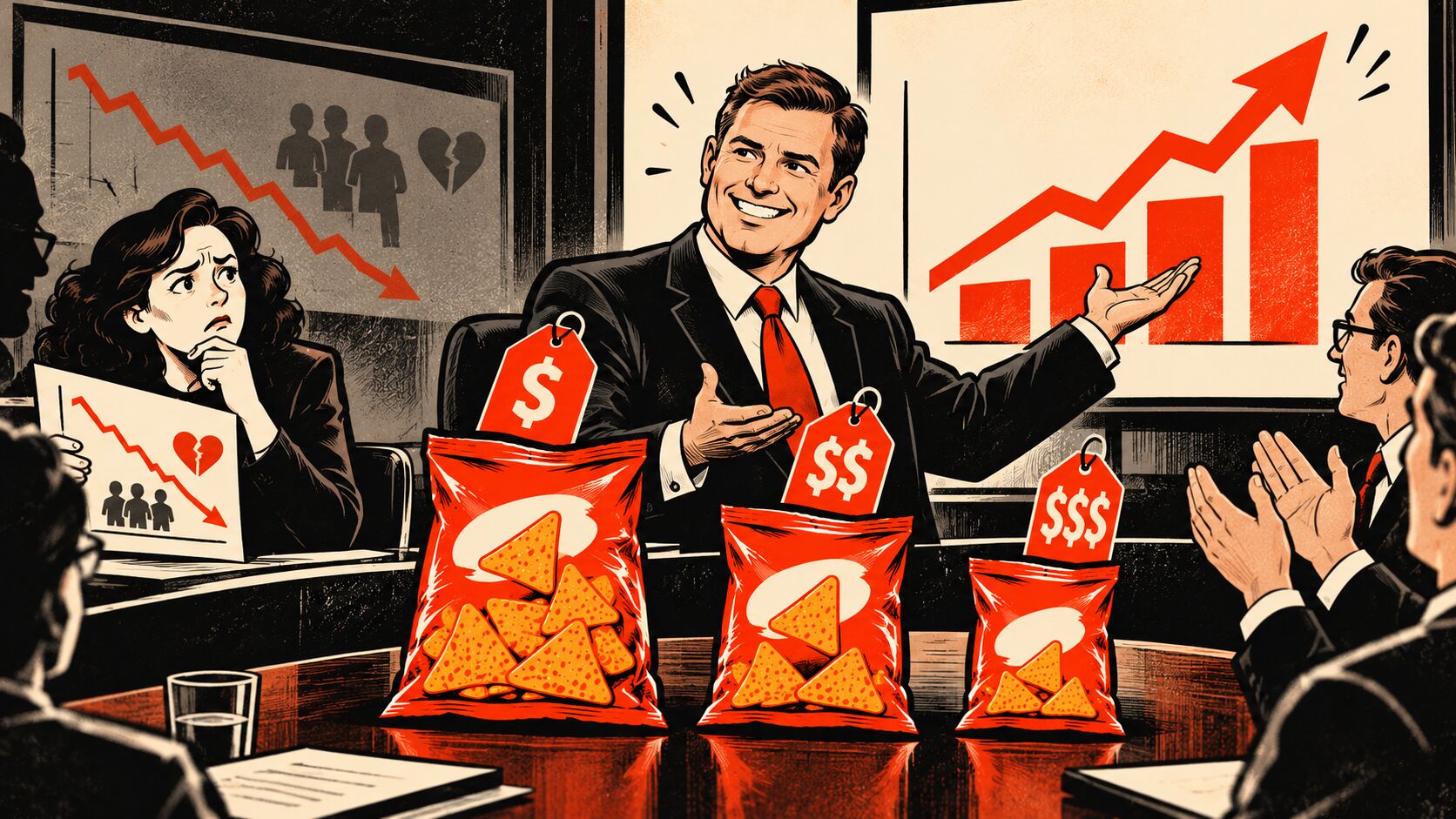
One of the ugliest possibilities in PepsiCo’s Doritos pricing fiasco isn’t that management failed to see the danger. It’s that people inside Frito-Lay saw it, warned about it, and watched the company embrace the strategy anyway.
Marketing employees interviewed by RippedMeOff about Frito-Lay’s 2016–2026 pricing practices describe a bitter divide over how to treat the company’s most valuable asset: its customers. On one side was aggressive Price Pack Architecture, including recurring price increases and package-weight reductions. On the other was a longer-term concern that consumers eventually tire of being charged more for less.
Those employees identify Jackie, a former senior leader in Frito-Lay revenue management, as a prominent opponent of the direction. They say she was pushed out of the pricing organization as Eric’s approach prevailed. The public employment timeline supports when the leadership transition occurred; the insiders’ account supplies the contested explanation for why.
If their account is accurate, PepsiCo had a remarkably expensive lesson delivered to its own conference room years before Walmart and shoppers delivered it at the checkout.
Jackie Wasn’t an Outsider Second-Guessing Pricing
Jackie understood Frito-Lay finance. Publicly available professional histories place her in financial planning, regional CFO responsibilities, and then Senior Director of Revenue Management and Pricing Strategy from August 2014 to March 2018. She wasn’t a brand manager wandering into a meeting to complain about expensive chips. Pricing was part of her job.
In a public professional recommendation, Jackie described recruiting a colleague into her pricing team.
The employees interviewed by RippedMeOff describe Jackie’s position as a financial argument, not a sentimental objection to making money. A brand may support higher prices because years of advertising, innovation, retail execution, and positive customer experiences have made it valuable. But using that loyalty to justify repeated price increases doesn’t replenish it. Eventually a household switches brands, stops buying as often, or stops buying at all.
The 2018 Leadership Change Deserves Scrutiny
The public career timelines show an unusually close handoff. In March 2018, Jackie moved from senior revenue-management leadership into Brand and Innovation Portfolio Management finance. At approximately the same time, Eric advanced from Director of Revenue Management Strategy to Senior Director of Revenue Management.
People interviewed by RippedMeOff say that transition was not a voluntary move by Jackie. They describe her being pushed out of revenue management after opposing the more aggressive pricing direction, with Eric’s approach winning management support.
Those are interview-based accounts, not a company-confirmed explanation of a personnel decision. Employment histories alone can’t establish anyone’s motives. But the distinction between what happened publicly and what insiders say happened behind the scenes shouldn’t bury the question: why did PepsiCo favor the strategy that prioritized extracting more revenue while brand-equity warnings went unheeded?
One Career Climbed. The Other Stayed at Senior Director.
The divergence afterward is difficult to overlook. Eric went on to become CFO of Walkers Snack Foods, held senior finance positions in Europe, became a vice president, and ultimately reached SVP and CFO of Global Strategy, Transformation & Technology.
Jackie took on important assignments of her own, including brand and innovation finance, business-unit CFO responsibilities, finance transformation, and integrated business planning. But her publicly listed seniority remained Senior Director through 2026, the same level she held in 2014. Her career stalled out.
A title doesn’t prove retaliation, but the contrast raises questions about what PepsiCo valued. According to the interviewed employees, the philosophy associated with Eric gained influence and recognition while Jackie’s objections failed to prevail. The organization appears to have celebrated the pricing machine while treating the warning about its long-term cost as an obstacle.
The Numbers Eventually Caught Up With the Strategy
During the pandemic and afterward, Frito-Lay’s price realization became a dominant engine of reported growth. In 2022, effective net pricing accounted for essentially all of Frito-Lay North America’s 17% organic revenue growth, while organic volume contributed nothing. In 2023, pricing contributed another 10 percentage points, even as organic volume fell.
Then came the part nobody could solve by adjusting the ounces in a bag.
In 2024, Frito-Lay North America reported a 2.5% unit-volume decline, a 1% revenue decline, and a 7% decline in operating profit. In 2025, after PepsiCo combined its North American foods reporting, savory-snack volume fell another 3%.
Broader inflation, changing eating habits, competition, and operating costs also shaped these results. The figures don’t prove any single pricing model caused every lost sale. They do, however, show the exact type of brand and volume risk that the employees say Jackie and her colleagues had warned about.
Bloomberg’s April 2026 investigation supplied the ugly retail details: some snack bags had exceeded $7, Doritos prices at Walmart had increased nearly 50% since 2021, and Walmart had warned PepsiCo that its prices were too high. Eventually the retailer gave Frito-Lay shelf space to cheaper alternatives and competitors.
The Reversal Came Years After the Warnings
In February 2026, PepsiCo announced suggested retail price reductions of up to nearly 15% on selected Doritos, Lay’s, Cheetos, and Tostitos products. It promised familiar snacks at lower prices and emphasized rebuilding consumer value.
That is what makes the reported internal disagreement so infuriating. The company was now spending management attention, marketing resources, and pricing dollars on the very problem employees say had been raised years earlier: preserving the consumer relationship rather than simply collecting more money from it.
Eric left Frito-Lay’s revenue-management role in 2019, so the decision to keep raising prices through COVID and resist broader reductions cannot be laid entirely at his feet. Senior executives, including CEO Ramon Laguarta, owned the later choices and the slow response. The pricing philosophy also had roots before Laguarta became CEO in October 2018, under Indra Nooyi’s leadership.
Blaming one designer of the pricing apparatus while excusing the people who kept using it would simply repeat PepsiCo’s accountability problem with a different spreadsheet.
What PepsiCo Should Be Asked to Explain
PepsiCo should have to answer whether its pricing initiatives were evaluated against long-term household loyalty, purchasing frequency, market share, and eventual customer reacquisition costs. It should explain how experienced finance leaders’ objections were assessed, why those objections failed to change the direction, and whether the executives who delivered short-term price gains were held accountable for the years that followed.
An executive warning that a profitable strategy could weaken future demand isn’t being difficult. Sometimes that’s the finance job PepsiCo most needs done.
The interviews place Jackie among those voices. The subsequent business record makes their warnings difficult to dismiss.
PepsiCo built a system that was very good at calculating how much extra customers might pay. The far more important question was how long those customers would keep paying. According to insiders, Jackie understood the distinction. PepsiCo learned it the expensive way.
Jackie, Eric and Frito-Lay Pricing FAQs
What role did Jackie hold at Frito-Lay?
Public professional histories list her as Senior Director of Revenue Management and Pricing Strategy from August 2014 to March 2018. She subsequently moved into brand and innovation finance and other senior finance roles at PepsiCo.
Was Jackie pushed out of revenue management?
Marketing employees interviewed by RippedMeOff say she was pushed out as Eric’s pricing approach gained favor. Public career histories confirm a March 2018 transition, but do not independently establish why the move occurred.
What was Jackie's objection to Price Pack Architecture?
According to the interview accounts, she objected to using repeated price increases and package-weight reductions in ways that threatened long-term brand equity and consumer loyalty. Price Pack Architecture itself can also be used for legitimate package and affordability decisions.
Did Eric cause all of Frito-Lay's later pricing problems?
No single executive made every decision. Eric led Frito-Lay revenue-management work during 2016–2019, while subsequent business leaders and PepsiCo executives were responsible for continuing the approach and responding to declining demand.
References
- Jackie, publicly listed PepsiCo career history (SignalHire)
- Jackie, LinkedIn professional profile
- Public LinkedIn recommendation describing Jackie’s Frito-Lay pricing team
- Eric, publicly listed PepsiCo career history (ContactOut)
- PepsiCo 2022 Form 10-K
- PepsiCo 2023 Form 10-K
- PepsiCo 2024 Form 10-K
- PepsiCo 2025 Form 10-K
- Bloomberg, April 7, 2026: Doritos at $7 a Bag Ended Up Costing PepsiCo Billions
- PepsiCo, February 3, 2026: Price reductions on selected snacks