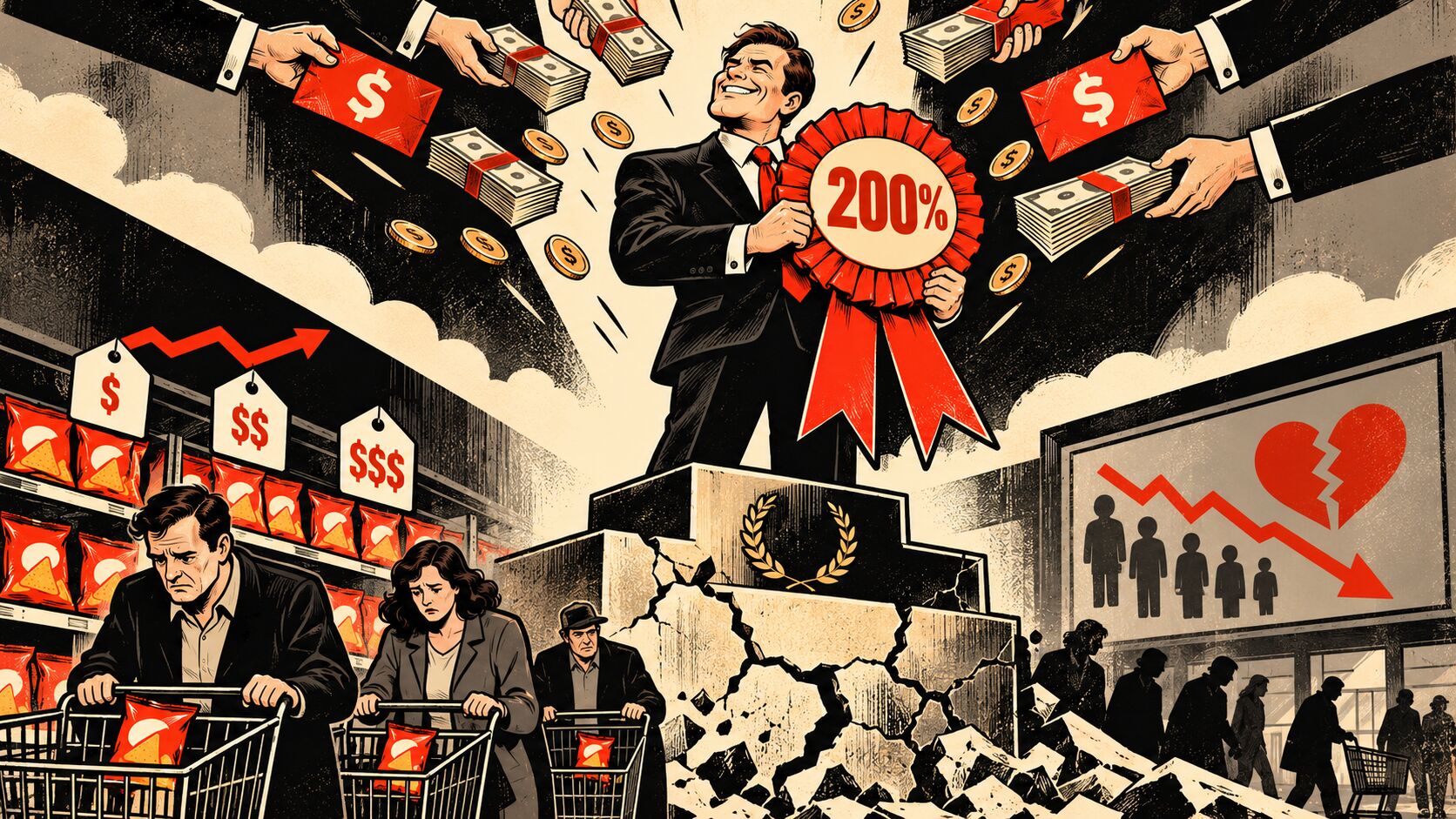
PepsiCo accomplished something remarkable: its incentive system declared spectacular success while its snack business was losing customers.
In its 2025 proxy, PepsiCo disclosed that performance-share awards covering 2022–2024 paid twice their target. Its revenue and earnings goals had been exceeded. Congratulations, apparently.
Meanwhile, in 2024, Frito-Lay North America lost 2.5% of unit volume, about 1% of revenue, and roughly 7% of operating profit. Customers were beginning to walk.
These were PepsiCo-wide awards, not Doritos-specific bonuses. But why did maximum rewards coincide with deteriorating demand in one of the company’s most important businesses?
The Maximum Payout Arrived as Frito-Lay’s Numbers Turned Sour
For 2022–2024, PepsiCo’s compensation-adjusted organic revenue performance averaged 8.6%, exceeding the 6.8% maximum goal. Core constant-currency EPS growth averaged 11.2%, above the 10.3% maximum goal.
Result: the 2022 performance-stock units paid 200% of target. CEO Ramon Laguarta earned 115,398 shares against a target of 57,699 under that award.
Those are PepsiCo’s own numbers.
The program rewarded executives for hitting its targets. It didn’t establish that loyal snack customers were becoming more loyal.
Higher Prices Made the Scoreboard Look Better
For years, Frito-Lay’s revenue-management machine produced growth through price realization rather than additional purchases. In 2022, effective net pricing accounted for essentially all of Frito-Lay North America’s 17% organic revenue growth. Organic volume contributed nothing. In 2023, pricing contributed another ten percentage points while organic volume weakened.
Inflation justified some increases. It didn’t justify ignoring the consumers who made those sales possible.
Raise a bag’s price, reduce its weight, and revenue per unit improves. The household that eventually switches brands doesn’t send finance an invoice marked lost loyalty.
Reward an initiative inside one measurement window, and its costs can spill into the next.
The Internal Warnings Weren’t About Being Anti-Profit
Marketing employees interviewed by RippedMeOff about Frito-Lay’s 2016–2026 operations describe sustained opposition to aggressive Price Pack Architecture and staggered “price up, weight out” decisions. They say employees responsible for brand development warned that repeatedly extracting more revenue could damage consumer loyalty and eventually require expensive efforts to win shoppers back.
Revenue management could quantify the immediate price gain. Brand finance had to defend repeat purchases, household penetration, and shoppers who didn’t need a discount.
Those warnings reportedly lost influence. Public filings don’t establish how individual employees were rewarded, but a company can listen closely to its pricing models and still fail to hear its customers.
PepsiCo Did Include Market Share. So Why Wasn’t It Enough?
PepsiCo also measured relative competitive performance, including market-share changes; its proxy says consumer perception and brand equity can inform that assessment. Cash flow, individual objectives, and other safeguards also mattered.
This wasn’t a system with no concern for competitive health. Similar financial performance measures appeared in PepsiCo’s executive compensation disclosures back in 2017, under Indra Nooyi. The incentive philosophy predated the current CEO.
If brand equity was considered, why didn’t weakening demand force an effective correction sooner? How much weight did loyalty really carry alongside price-driven revenue?
PepsiCo doesn’t disclose individual Frito-Lay revenue-management scorecards. We cannot attribute a specific shrinkflation bonus to any particular executive. The public corporate incentives nevertheless deserve scrutiny.
The Shareholders’ Scorecard Told a Less Flattering Story
Not all awards reached the maximum. The contrast is revealing.
For the 2022–2024 period, its separate long-term cash award based on relative shareholder returns paid only 70% of target. PepsiCo reported a three-year total shareholder return of negative 4.6%, placing it at the 35th percentile among its compensation peers.
The next cycle reflected weaker performance: 2023–2025 performance shares paid 88.4%, and the relative-return cash award paid 50% of target.
Later disappointment doesn’t erase an earlier maximum award or restore a lost Doritos customer.
Laguarta’s 2023 annual cash incentive was $6.75 million, according to PepsiCo’s filings. For 2025, it was $3.136 million. Those awards reflect the whole corporation, but illustrate how compensation and consumer loyalty operate on different timetables. PepsiCo also discloses clawback provisions and mechanisms to keep executives accountable for prior business-unit results after they move roles. The open question is whether those safeguards fully capture slow-moving brand damage rather than just obvious financial underperformance or misconduct.
Customers Left. The Company Started Paying to Bring Them Back.
Bloomberg’s April 2026 investigation reported that Walmart warned PepsiCo for more than a year about excessive snack pricing. Some bags exceeded $7; the price of Doritos at Walmart had climbed nearly 50% since 2021, according to spending data Bloomberg cited. Walmart eventually shifted shelf space toward cheaper alternatives.
After engaging activist investor Elliott, PepsiCo outlined affordability and advertising investments in December 2025. In February 2026, it announced selected snack price cuts of up to nearly 15%.
In Q3 2026, PepsiCo Foods North America reported a 12% decline in core constant-currency operating profit. The segment includes Quaker, and costs beyond pricing contributed. Still, the company is accepting lower pricing realization while trying to restore demand.
A Bonus Plan That Can Celebrate the Harvest Must Measure the Damage
PepsiCo’s board should explain how it balances pricing gains against durable brand economics. Revenue, EPS, and market-share targets cannot, by themselves, establish that the underlying customer relationship is stronger.
The real test is whether pricing gains exceeded the eventual cost of lost households, lower purchase frequency, discounts, retailer support, and customer reacquisition, including costs beyond the original incentive window.
PepsiCo knew how to count the extra money from a Doritos bag. It was slower to count the customers who stopped buying one.
The result is more embarrassing than bad arithmetic: a functioning incentive system rewarding an incomplete definition of success.
PepsiCo Executive Incentives and Frito-Lay FAQs
Did PepsiCo executives receive maximum incentive payouts while Frito-Lay sales weakened?
Yes. PepsiCo’s 2022 performance-share awards, evaluated over 2022–2024, paid out at 200% of target based on company-wide revenue and EPS performance. Frito-Lay North America experienced declining unit volume and profit in 2024. The share awards were not specific to Doritos pricing.
Was PepsiCo executive compensation based only on revenue and earnings?
No. PepsiCo also considered competitive market-share performance, cash flow, shareholder returns, and individual objectives. Its disclosures say brand equity and consumer perception may inform competitive-performance assessments. The criticism concerns whether those safeguards adequately captured delayed consumer damage.
Were all of PepsiCo's long-term incentive awards paid at 200%?
No. The 2022–2024 relative-shareholder-return cash award paid at 70% of target. For 2023–2025, the performance-share award paid at 88.4% and the relative-return cash award paid at 50% of target.
Did the pricing reversal restore Frito-Lay's profits?
Not yet. PepsiCo reported improving snack volume trends in 2026, but its broader North American foods operation still posted declining core constant-currency operating profit in the third quarter. Volume stabilization and restoring prior profit margins are separate challenges.
References
- PepsiCo 2025 proxy statement: 2022–2024 performance awards, executive scorecards and payouts
- PepsiCo 2026 proxy statement: 2023–2025 award payouts, compensation framework and governance
- PepsiCo 2018 proxy statement: financial incentive measures under Indra Nooyi
- PepsiCo 2024 proxy statement: 2023 executive compensation
- PepsiCo 2022 Form 10-K
- PepsiCo 2023 Form 10-K
- PepsiCo 2024 Form 10-K
- Bloomberg, April 7, 2026: Doritos at $7 a Bag Ended Up Costing PepsiCo Billions
- PepsiCo, December 8, 2025: turnaround priorities after Elliott engagement
- PepsiCo, February 3, 2026: selected snack price reductions
- PepsiCo third-quarter 2026 SEC earnings release