
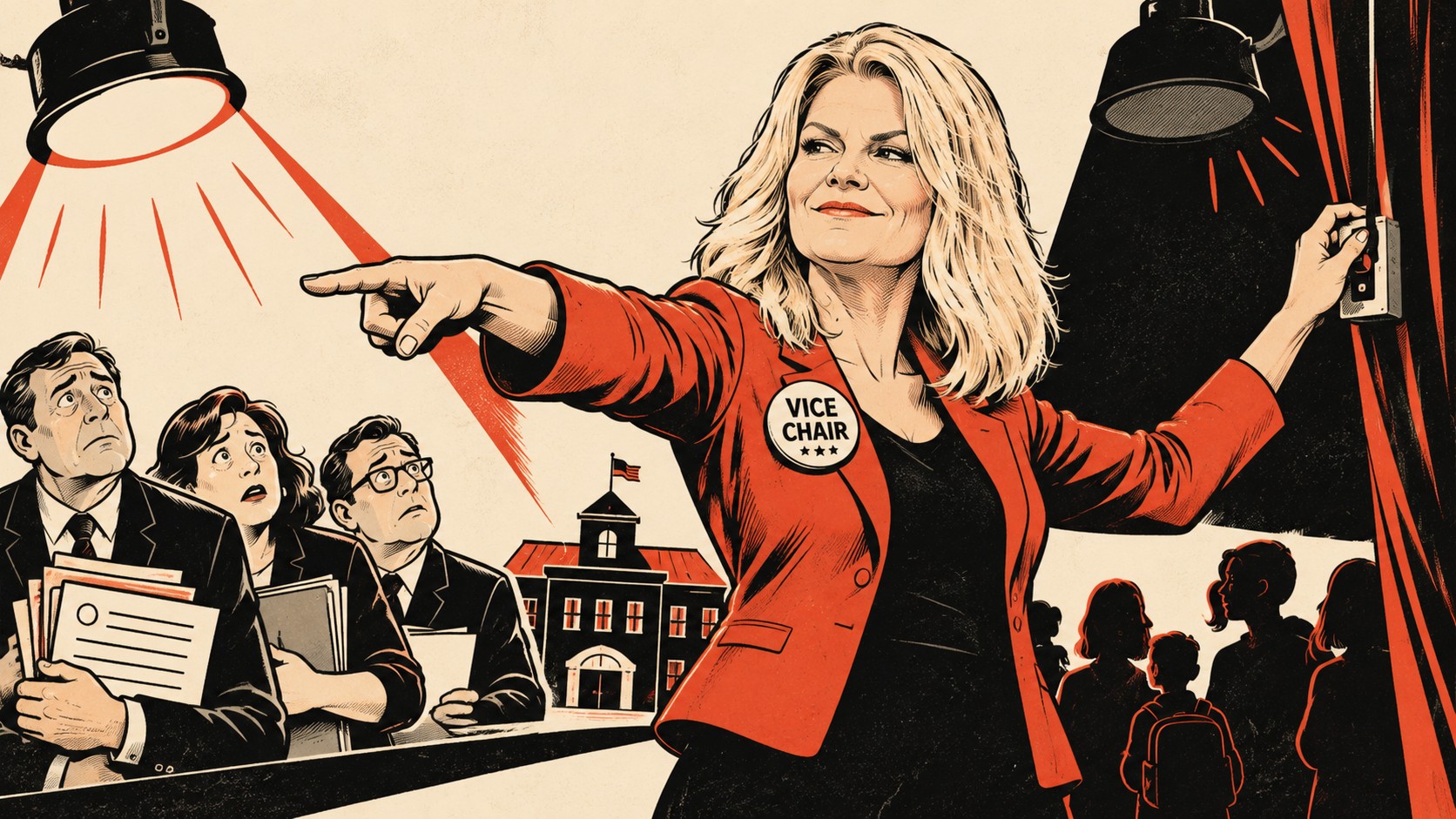
Moms for Liberty has a message for public officials across America: Hold Leaders Accountable.
Those three words appear prominently on the organization’s website. They’re part of its publicly stated approach to political advocacy.
But a rather uncomfortable question now confronts the parental-rights organization.
What happens when the leader facing scrutiny is one of its own?
Shellie Flockhart, an Iowa city councilwoman and vice chair of the Dallas County chapter of Moms for Liberty, recently appeared in a Republican political advertisement declaring that Democratic congressional candidate Sarah Trone Garriott is dangerous to children.
There was one considerable complication.
Flockhart herself pleaded guilty to child endangerment in 2017 after driving drunk with two of her children in the vehicle.
That conviction became the subject of national reporting on October 24, 2026. Flockhart subsequently acknowledged the incident and emphasized her rehabilitation, sobriety, and Christian faith.
Her personal response is a story in its own right, one we have already examined in Shellie Flockhart’s Gospel of Hypocrisy: Judgment for You, Christian Grace for Me.
But there is another party whose publicly stated principles deserve examination: Moms for Liberty.
The organization didn’t produce the advertisement. It wasn’t the sponsor. There is no established evidence that it selected Flockhart for the commercial or coordinated her appearance.
Nevertheless, Flockhart is a chapter officer whom Moms for Liberty has publicly presented as a parental-rights advocate.
That makes the organization’s leadership standards a legitimate subject of inquiry.
And those standards are not something critics invented. Moms for Liberty wrote them down itself.
“Hold Leaders Accountable.” Their Words, Not Ours.
Visit the official Moms for Liberty website and the organization’s values are prominently displayed.
It says it stands for truth, builds relationships, and empowers others. Its mission centers on organizing parents to defend parental rights at every level of government.
Under its explanation of how it operates, one heading stands out:
Hold Leaders Accountable.
The organization says it holds decision-makers accountable or works to replace them with people who share its understanding of liberty.
Fine. That is a legitimate mission for an advocacy organization.
But any organization making accountability a central part of its public identity invites questions about the standards it applies internally.
Does accountability operate in both directions? What happens when a chapter leader becomes the subject of a controversy directly involving the protection of children? Who examines the conduct, and what determines whether it warrants a response?
These questions require something more substantial than a slogan.
After all, accountability is not much of a principle if nobody can explain when or how it applies.
Shellie Flockhart Is Not Some Random Member
This is an important distinction.
Flockhart is not merely someone who once attended a Moms for Liberty meeting or happened to express support for the organization’s political goals.
The official Dallas County chapter leadership page lists her as its vice chair.
She is also an elected city councilwoman in Dallas Center, Iowa.
Her leadership position is publicly documented by Moms for Liberty itself.
More significantly, the organization has featured her beyond the confines of her local chapter.
On August 5, 2025, Moms for Liberty’s educational initiative, M4L Academy, included Flockhart among the featured speakers for a virtual event titled Campus Briefing, Special Edition: Curriculum Red Flags.
The organization’s official event listing introduced Flockhart as an advocate for parental rights and described her work promoting transparency and family values.
The biography also highlighted her school involvement, political volunteering, and community service.
It presented her as someone helping parents protect their children’s futures.
That is significant context.
The organization wasn’t simply hosting an unfamiliar individual whose relationship to Moms for Liberty was incidental. It was giving a chapter officer a platform to speak about educational issues and presenting her credentials favorably to its audience.
That doesn’t establish that the organization knew about her 2017 conviction. Nor does it establish that it was obligated to reject her participation because of it.
But it does demonstrate that Flockhart’s public role within Moms for Liberty extended beyond a name on a membership roster.
When an organization promotes someone as a trusted advocate, it becomes reasonable to ask what standards govern that decision.
A Child-Endangerment Conviction and a Political Advertisement About Protecting Children
The underlying controversy is straightforward.
According to court records reported by The Washington Post, Flockhart was arrested in 2017 following an incident involving drunk driving with her children, then ages 8 and 11, in the vehicle.
She subsequently pleaded guilty to misdemeanor child endangerment and operating a vehicle while intoxicated. She received fines and probation.
Nearly a decade later, she appeared in an advertisement funded by the Congressional Leadership Fund, a Republican-aligned super PAC, criticizing Trone Garriott’s legislative positions on transgender-related issues.
Flockhart told viewers:
“When it comes to our kids, Sarah is just plain dangerous.”
The PAC’s argument concerns a political disagreement about school policy. Flockhart’s conviction concerns an actual criminal child-endangerment offense.
Those are different kinds of conduct, and they should not be confused.
That distinction is precisely why questions arose about her role in the advertisement.
Flockhart has publicly acknowledged the seriousness of her past actions and described her continued commitment to sobriety. Her recovery deserves to be considered.
But her decision to participate in a public accusation about danger to children also invites scrutiny of her credibility as the messenger.
Moms for Liberty did not make that advertising decision, as far as the available reporting establishes.
Yet it now has a chapter leader at the center of a national controversy involving the very subject—children’s safety—that features prominently in its public advocacy.
Whether the organization considers that a matter for internal review is a question only its leadership can answer.
Moms for Liberty Has Held Its Own Leaders Accountable Before
There is an important precedent here, and it comes directly from Moms for Liberty.
In November 2023, the organization’s national leadership issued a public message concerning two Kentucky chapter chairs who had been photographed with members of the Proud Boys. According to the organization’s own account, one held a Proud Boys flag and the other displayed a hand gesture associated with the group and white supremacy.
The national executive board voted to remove both chapter leaders.
Its explanation was explicit: their actions demonstrated poor judgment and conflicted with organizational values.
The organization emphasized that its own leaders must be accountable for conduct it regarded as indefensible.
That November 14, 2023, statement remains publicly available on the Moms for Liberty website.
This history matters because it demonstrates that the national organization has previously exercised oversight over chapter leadership.
It has made decisions about conduct that it believes conflicts with its values. It has removed officers. And it has publicly explained those decisions.
The 2023 incident and Flockhart’s situation are not identical. One involved photographs taken during the leaders’ tenure; the other involves a criminal conviction from years earlier and a recent political advertisement.
Different facts may reasonably warrant different outcomes.
But that doesn’t eliminate the relevance of the precedent.
It establishes that Moms for Liberty recognizes internal leadership accountability as more than a theoretical principle.
The question now is what criteria distinguish one situation from another.
Does Redemption Settle the Leadership Question?
Flockhart has described her past conduct as inexcusable and says she has maintained her sobriety for years.
Those facts matter.
Someone who has overcome addiction should not be permanently excluded from civic life, volunteer organizations, or public service simply because of a past criminal conviction.
Indeed, rehabilitation is one of the principal reasons society allows people to complete their sentences and move forward.
An organization could reasonably determine that a rehabilitated person remains qualified to serve in leadership.
But it should be able to articulate that position.
And Flockhart’s past conviction is not the only relevant fact.
She recently chose to participate in an advertisement making a sweeping accusation about another person’s danger to children. That decision is contemporary, voluntary, and directly connected to the controversy.
An organizational review could therefore distinguish between a nine-year-old criminal offense and a present-day decision about public political messaging.
It could also conclude that her advertisement had no connection to her duties as a chapter officer.
Those are possible positions.
What matters is whether Moms for Liberty can explain the standards it applies rather than leaving observers to guess.
Five Questions Moms for Liberty Can Answer
A substantive response from the Dallas County chapter or national leadership could address several straightforward questions.
- Was the organization aware of Flockhart’s 2017 child-endangerment conviction when she assumed a chapter leadership position? If so, did officials consider her rehabilitation or impose any disclosure requirements?
- What standards govern the selection and continued service of chapter officers? Do they address criminal history, public conduct, or reputational controversies involving an officer?
- Did Moms for Liberty have any involvement in Flockhart’s appearance in the Congressional Leadership Fund advertisement? The available reporting does not establish any involvement, but a direct answer would clarify the relationship.
- Does the organization consider her recent political advertisement relevant to its leadership standards? If not, what distinguishes an officer’s personal political activity from conduct that warrants organizational review?
- Does Moms for Liberty believe its existing standards have been satisfied in this case? If a review occurred, what was considered? If no review was necessary, why?
None of these questions presupposes that Flockhart must be removed.
They ask an organization that publicly embraces accountability to explain how accountability works within its own ranks.
They also give Moms for Liberty an opportunity to defend its decisions and correct any inaccurate assumptions about its role.
The Difference Between an Organization’s Values and Its Actions
Advocacy organizations exist to promote ideas and mobilize supporters. Moms for Liberty’s emphasis on parental rights, civic participation, and education policy fits that description.
Its members are entitled to advocate for their positions and criticize politicians whose policies they oppose.
But public credibility depends partly on whether stated principles are understandable and consistently applied.
When an organization says it stands for truth, promotes transparency, and holds leaders accountable, questions about its own leadership are not inherently hostile to its mission.
They are a natural extension of it.
Flockhart’s conviction does not establish wrongdoing by Moms for Liberty. Her participation in the PAC advertisement does not prove that the organization endorsed its message.
And there is no verified evidence that the organization concealed her history or deliberately overlooked relevant information.
Those distinctions are important.
Nevertheless, the combination of her documented leadership role, the organization’s public promotion of her advocacy, and its own history of disciplining chapter officers presents a legitimate organizational accountability question.
Moms for Liberty has demonstrated that it knows how to publicly explain difficult leadership decisions.
Whether it considers this controversy one that requires such an explanation remains to be seen.
Who Holds the Watchdogs Accountable?
Moms for Liberty has chosen to make accountability part of its public mission.
It has put those principles on its website, incorporated them into its advocacy, and previously invoked them when removing chapter officers.
Now one of its Iowa vice chairs is facing national scrutiny following the revelation of a child-endangerment conviction and her participation in a political advertisement alleging that another person is dangerous to children.
Flockhart has addressed her personal conduct. The Republican super PAC has responded to press inquiries about its advertisement.
The organizational question remains separate.
What does Moms for Liberty believe accountability requires of its own leaders?
Perhaps it believes that Flockhart’s rehabilitation and completed legal obligations settle the matter. Perhaps it considers her advertising role wholly independent of her chapter responsibilities. Perhaps its leadership standards call for additional review.
Any of those positions can be explained.
A meaningful accountability standard should be sufficiently clear that supporters, critics, members, and the public can understand how it operates.
There is no need to presume misconduct or demand a predetermined punishment.
There is simply a question that follows directly from Moms for Liberty’s own declared principles.
If holding leaders accountable is part of the mission, what happens when the leader in question is one of your own?
That is a question worth answering.
References
- Moms for Liberty — Official Mission, Values, and Accountability Principles
- Moms for Liberty — Dallas County, Iowa, Chapter Leadership
- Moms for Liberty Academy — August 5, 2025, Event Featuring Shellie Flockhart
- Moms for Liberty — November 14, 2023, Leadership Accountability Statement
- The Washington Post — October 24, 2026, Reporting on Shellie Flockhart
- Mediaite — Flockhart’s Public Response