
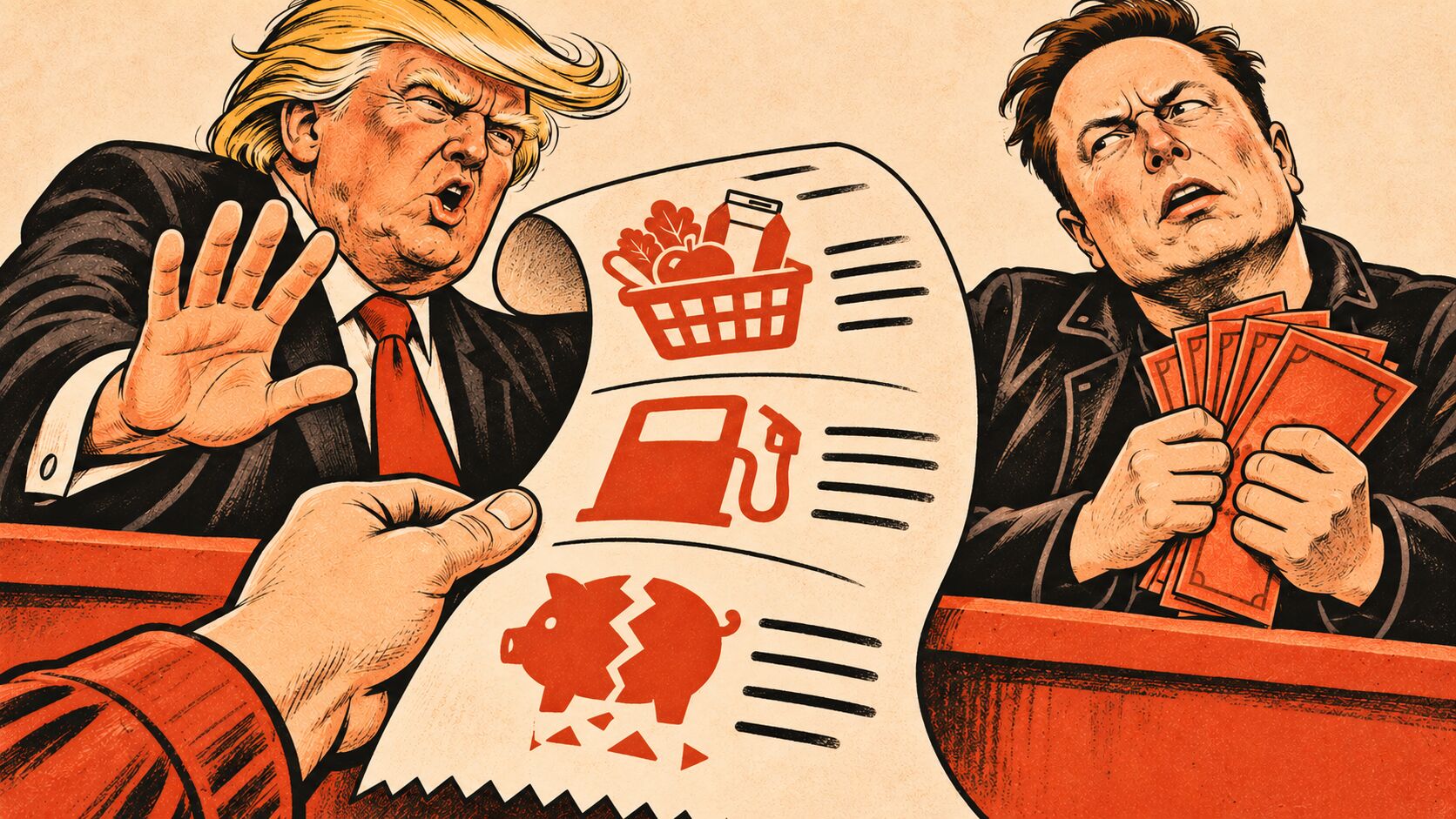
Paxton and Ramaswamy lost. The larger rebuke belongs to a political culture that confused cruelty with strength and treated accountability as an insult.
Donald Trump asked Americans to believe that his strength would make their lives easier. Elon Musk brought the billionaire-genius branding. Ken Paxton and Vivek Ramaswamy offered their own versions of the bargain: trust the aggressive man, overlook the ugliness, and wait for the results.
On Tuesday, the results arrived.
James Talarico defeated Paxton in Texas. Amy Acton defeated Ramaswamy in Ohio. Two candidates with Trump’s backing discovered that proximity to the president could also mean proximity to the exit. [1, 2]
There is something satisfying about watching men who market themselves as uniquely formidable encounter an ordinary performance review.
They had the confidence. They had the money. They had endless explanations for why everyone criticizing them was the problem.
Voters had a different assessment.
The country gave Trump a failing grade
The warning signs were hardly subtle. A Reuters/Ipsos poll completed November 2 put Trump’s job approval at 32%. Among independent registered voters, half described their congressional vote as opposition to Trump; just 13% described it as support. [3]
That is a difficult audience for a campaign built around demanding more appreciation.
The dissatisfaction was especially pronounced where Trump had promised relief. An AP-NORC poll published October 1 found that only 17% of adults approved of his handling of the cost of living, while 26% approved of his economic performance. [4]
A politician can dispute an opponent’s description of the economy. He faces a harder task persuading someone that their own household budget is propaganda.
This is where the strongman sales pitch becomes exhausting. It asks people to accept every boast as evidence of competence, then treat every disappointing result as somebody else’s responsibility. The leader gets credit in advance. Accountability is always postponed.
Americans are entitled to cancel that arrangement. Supporting a candidate two years ago creates no obligation to keep defending him while the promised benefits remain out of reach.
An election is a hiring decision with a review date. Loyalty should depend on performance.
The checkout counter kept better records
Trump set the terms of this argument himself. His own White House website preserved his promise to drive prices down rapidly upon taking office. In July 2025, it marked the affordability pledge “PROMISE KEPT.” [5]
How considerate of the seller to complete the customer satisfaction survey.
The latest available inflation report tells a less celebratory story. The Bureau of Labor Statistics reported that consumer prices rose 3.7% over the year through September 2026, up from August’s 3.4% annual rate. Prices increased 0.6% during September alone. [6]
Those figures describe continued price increases on top of the expensive baseline households already faced.
At the pump, the Energy Information Administration recorded a national regular-gasoline average of $4.153 a gallon for November 2, about $1.13 higher than a year earlier. Prices had fallen from the previous week, which offered some relief. The annual comparison remained ugly. [7]
For someone buying 15 gallons, that year-over-year difference works out to about $17 per fill-up. That is an illustration using the national average; actual purchases and local prices vary. It is also a more useful measure of affordability than the volume of applause at a rally.
Presidents cannot set every price. They can, however, be judged against their promises and held responsible for policies that affect costs. Trump volunteered for that comparison when he presented himself as the person who would rapidly fix the problem.
Voters were sold relief. They are allowed to notice when the delivery does not match the advertisement.
The peace promises came with a fuel surcharge
The same gap appears in Trump’s promises about war.
During the campaign, he repeatedly claimed he could end the Russia-Ukraine war within 24 hours. Asked about that claim in a March 2025 interview, he explained that he had been “a little bit sarcastic.” [8]
An extraordinary clarification for anyone who thought they were evaluating a foreign policy rather than auditioning for the role of audience.
By November 2026, Russia’s war against Ukraine continued, and the United States was eight months into its conflict with Iran. Reuters reported that the Iran war had disrupted Gulf oil and gas supplies and pushed fuel prices higher. [9]
The consequences reach households that never volunteered to finance another demonstration of presidential toughness. A more expensive commute does not become easier because the man directing foreign policy sounds pleased with himself.
War also deserves a more serious standard than the campaign language used to sell easy solutions. People die. Families are displaced. Service members and civilians carry risks that no triumphant post can erase.
A leader who promises exceptional mastery invites exceptional scrutiny when events expose the limits of that promise. He owes the public a credible account of the goals, costs, and route out.
The public owes him no applause for discovering that international conflict is complicated.
Musk bought airtime and discovered its limits
Elon Musk’s contribution to this political project came with an enormous price tag.
Reuters reported on October 12 that he had already spent roughly $366 million during the election cycle. That included $158 million for the Senate Leadership Fund and $10 million for a PAC supporting Paxton. These were reported totals at that point in the campaign, not a final election-spending tally. [10]
Paxton still lost.
That result does not make money harmless in politics. Vast spending can purchase attention, finance attacks, and force opponents to spend precious time answering them. It gives wealthy individuals a reach most citizens cannot imagine.
It also has a limit: advertising cannot require the audience to approve of the product.
Musk’s political authority deserves the same scrutiny as his spending. Great wealth gives someone resources. It does not establish that every public-policy judgment they make is wise, accurate, or entitled to obedience.
His Department of Government Efficiency provided a revealing example. In March 2025, Reuters found serious errors in DOGE’s savings claims, including an $8 million contract presented as an $8 billion saving and another contract counted three times. Musk acknowledged that mistakes would occur and be corrected. [11]
Three extra zeroes make a wonderful press release. They do less for the federal budget.
Government reform deserves accurate accounting. A billionaire’s reputation should never function as an exemption from showing the work.
Musk could help finance the campaign. He could not make voters sign off on its performance.
Paxton finally had to carry his own baggage
Paxton’s defeat gives this wider argument a particularly useful face.
RippedMeOff has already examined his record of scandals, excuses, and other people’s money. The recurring question is straightforward: when his conduct creates a problem, who bears the cost?
Consider the whistleblower case. In 2025, Paxton dropped the appeal of a roughly $6.6 million civil judgment involving four former deputies who said they were fired after reporting him to the FBI. The judgment left Texas responsible for payment. His office continued to reject the claims as baseless. [12]
That was a civil employment case, and the obligation belonged to the state. Those distinctions make the political question sharper: why should taxpayers keep absorbing the consequences while the official at the center seeks a promotion?
The Senate race offered a different allocation of responsibility. This time, Paxton was asking for something voters could personally refuse.
They did.
Public trust requires more than a succession of explanations for why an official can remain in office. It requires a reason to believe that giving him more power will serve the people who must live with the consequences.
Paxton had years to supply that reason. Texans were entitled to find the answer inadequate.
Ramaswamy showed voters what his toughness meant
Ohio supplied an especially nasty example of the political style at issue.
Ramaswamy’s campaign used Acton’s estranged mother in an attack advertisement questioning her honesty. AP reported that the mother had lost custody of her children after their stepfather was indicted for raping Acton as a child. [13]
Ramaswamy defended the advertisement as a challenge to Acton’s truthfulness. It drew condemnation across party lines, and his campaign eventually took it off the air. [2]
The decision to run it remains revealing. Someone seeking authority over millions of people saw a rival’s childhood trauma and found campaign material.
That is a judgment voters can assess directly. They do not need a consultant to explain the strategy or a focus group to establish whether it was clever. The willingness to make the advertisement tells them something about the person asking for their trust.
Calling this toughness is generous. It takes very little courage to assemble an attack on someone else’s worst childhood experiences. Exercising restraint would have required a quality the campaign apparently valued less than the possibility of landing a blow.
Acton won. Her victory cannot tell us precisely how many votes the advertisement cost Ramaswamy. It does establish that the attack failed to secure the outcome he wanted.
For a political culture that treats humiliation as proof of dominance, that is an instructive result.
America wants officials who can be checked
The strongest evidence for a demand for balance comes from voters themselves.
The AP Voter Poll found that about seven in ten voters wanted Congress to do more to check presidential power. About two-thirds said Trump’s policies had worsened the economy. Only about half viewed the Democratic Party favorably. [14]
Taken together, those findings suggest a public demanding correction without offering unconditional devotion to the replacement team.
That is a healthy instinct. Government should contain people capable of questioning a president, investigating an ally, and rejecting a bad idea without first consulting the leader’s mood.
Balance has practical meaning. It means oversight of spending, scrutiny of conflicts, and an expectation that decisions affecting millions can survive questions. It means political opponents remain fellow citizens with rights. It means public office carries duties that outlast the thrill of winning it.
A country can want vigorous debate and still be sick of bullying. It can support ambitious reform and still require the arithmetic to add up. It can care about national security and still ask why another promised shortcut has produced another costly conflict.
Those expectations are basic conditions of employment.
The Democrats taking office should pay particular attention to that last point. Winning against an unpopular administration creates an opportunity to govern. The work begins with results people can recognize in their lives.
The public is allowed to reject a bad deal
There is room to enjoy these defeats. Men who have spent years mistaking aggression for merit have earned a little discomfort when voters decline to reward them.
The more useful lesson concerns the bargain they offered.
Trump’s promises invited voters to expect relief. Musk’s claims of competence invited scrutiny of the numbers. Paxton’s conduct invited questions about public trust. Ramaswamy’s campaign invited voters to examine his judgment.
Each wanted the advantages of being treated as exceptional. Each deserved to be measured against an ordinary standard: did you earn the authority you are asking us to give you?
Tuesday’s results delivered a substantial refusal. The durability of that judgment will depend on what happens next, including whether the winners understand why they were hired.
For now, the men who sold the public their dominance can spend some time considering its limits.
America has paid enough for the performance. It is entitled to demand that the people in charge finally do the job.
References
- Associated Press. Texas Senate election result.
- Associated Press. Ohio governor election result and campaign backlash.
- Reuters. November 2 Reuters/Ipsos approval poll.
- Associated Press. AP-NORC poll on economic and cost-of-living approval.
- The White House. July 21, 2025 assessment of campaign promises.
- U.S. Bureau of Labor Statistics. September 2026 Consumer Price Index, released October 14.
- U.S. Energy Information Administration. Gasoline and Diesel Fuel Update, November 3 release with November 2 prices.
- Roll Call Factba.se. Full Measure interview transcript, March 16, 2025.
- Reuters. November 4 analysis of the midterms, Iran, energy, and Ukraine.
- Reuters, via Investing.com. Musk election spending reported October 12, 2026.
- Reuters. March 2025 investigation of errors in DOGE savings claims.
- The Texas Tribune. Paxton drops whistleblower judgment appeal, July 3, 2025.
- Associated Press. Ramaswamy campaign confirms advertisement featuring Acton’s estranged mother.
- Associated Press. AP Voter Poll analysis of the 2026 midterms.