
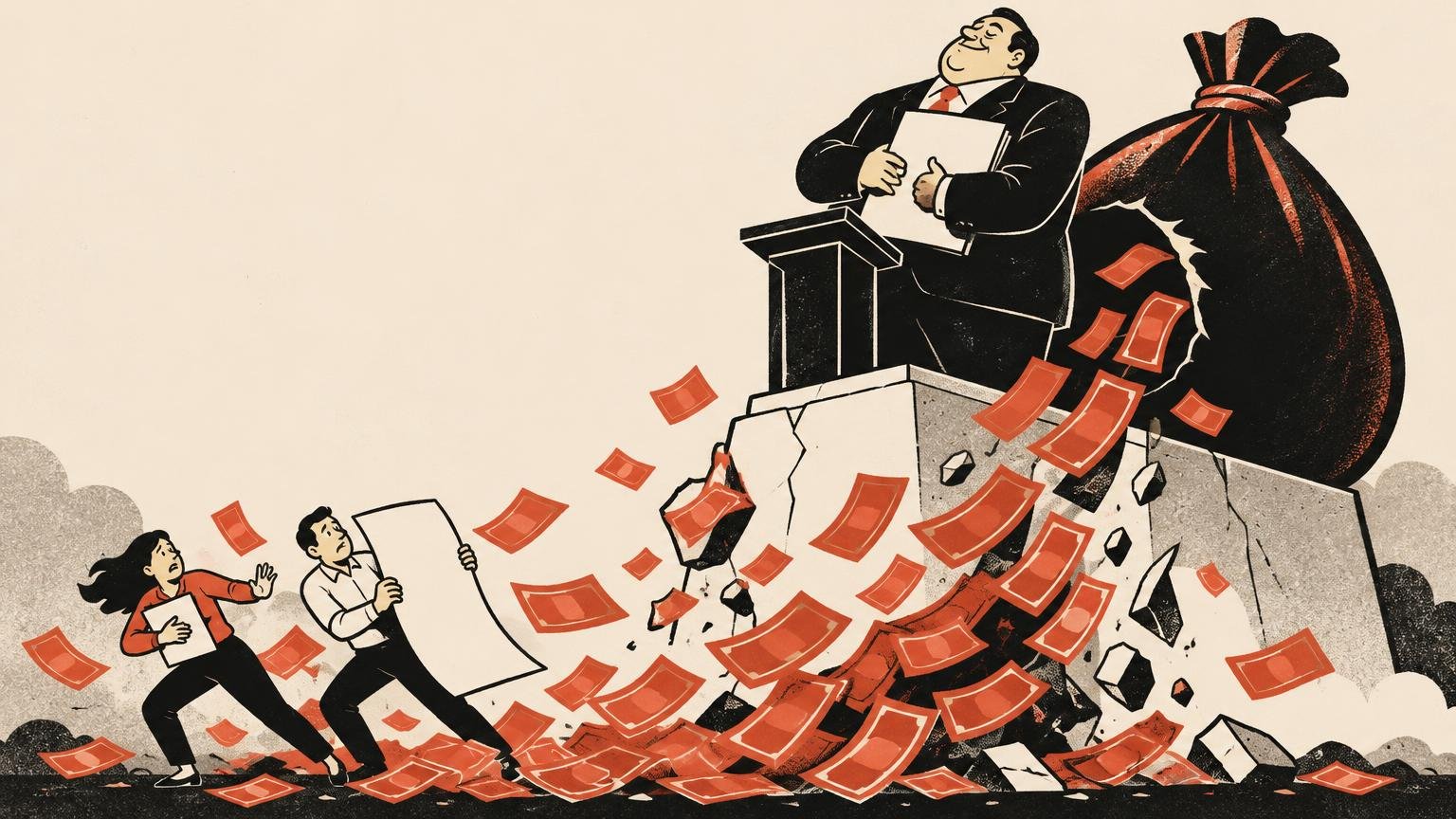
Four former senior employees of the Texas attorney general’s office proved that the office violated the Texas Whistleblower Act. The resulting judgment was approximately $6.6 million. Ken Paxton’s office appealed, then Paxton abandoned that appeal in July 2025, leaving Texas responsible for the judgment, subject to a legislative appropriation that reporting said was still needed. The award included lost pay, emotional-distress damages, legal fees and related costs. Unpaid amounts could accrue interest.
That is the cleanest introduction to the Ken Paxton scandals: public employees reported suspected misconduct, lost their jobs and spent years pursuing a remedy, while the financial liability landed on Texas. Paxton did not personally receive a criminal conviction from that case, and the judgment was against the Office of the Attorney General under a civil preponderance-of-the-evidence standard. But the finding is real, the consequences are real, and roughly $6.6 million is an expensive monument to an office that apparently mistook retaliation for personnel management.
The whistleblowers paid first, and Texas was handed the bill
The four successful plaintiffs were among eight senior officials who reported Paxton to the FBI in 2020. Their concerns centered on Paxton’s relationship with Austin developer and campaign donor Nate Paul. In April 2025, Travis County District Judge Catherine Mauzy found that the four plaintiffs had proved the attorney general’s office violated the state whistleblower law.
The human cost should not disappear behind the courtroom total. The judgment covered former public employees who lost income and claimed emotional harm after raising alarms through channels intended for exactly that purpose. An attorney general’s office should understand why whistleblower protections exist. Instead, four former employees had to establish in court that the office charged with enforcing Texas law had violated one.
Paxton later dropped the appeal. That did not transform the judgment into a personal payment from him; the available reporting placed responsibility on Texas and said lawmakers still needed to appropriate the money. Accountability becomes remarkably convenient when the official keeps the title and the public inherits the invoice.
Nate Paul, impeachment and the limits of an acquittal
The Nate Paul controversy moved beyond employee complaints into impeachment. On May 27, 2023, the Texas House adopted 20 articles against Paxton. The allegations included misuse of official power and actions intended to benefit Paul. The official House record documents the vote, while the Texas Senate’s impeachment archive preserves the proceedings that followed.
The outcome must be stated plainly: on September 16, 2023, the Senate acquitted Paxton on every one of the 16 articles tried. Four remaining articles were dismissed without trial. The Justice Department also decided not to charge Paxton in its federal investigation before the end of the Biden administration, according to Associated Press reporting. The department supplied no public explanation for that decision.
Those outcomes matter. An acquittal is an acquittal, dismissed articles were not tried, and a prosecutor’s decision not to charge is not a conviction hiding under a different hat. But non-prosecution is also not a factual ruling that every reported act never happened. Paxton’s preferred rhetorical laundering cycle—scrutiny becomes persecution, survival becomes vindication, and unanswered conduct vanishes in a puff of political smoke—is far broader than the legal record supports.
Paul later pleaded guilty in a separate federal financial case involving false statements to a financial institution. He received five years of supervised release, a $1 million fine and nighttime home confinement. That conviction does not prove Paxton committed the conduct alleged during impeachment. It does, however, prevent anyone from presenting Paul’s wider legal troubles as some imaginary invention created solely to inconvenience the attorney general.
Servergy produced a fine, restitution and years of evasive triumphalism
Paxton’s securities history requires three separate chapters because blending them would either overstate the case or sanitize it. First, the Texas State Securities Board fined him $1,000 in 2014 after he admitted soliciting clients for an investment-advisory firm without being properly registered as an investment-adviser representative. A later SEC complaint described the state order as finding that he had not personally disclosed his compensation arrangement to clients.
Second, a 2015 indictment charged Paxton with two first-degree securities-fraud counts and a registration-related offense connected with Servergy. The SEC separately alleged that Paxton received 100,000 Servergy shares for recruiting investors. Those were allegations, not findings of guilt, and a federal judge dismissed the SEC’s civil case in 2017.
Third, the criminal prosecution ended through pretrial diversion rather than a trial verdict. Under the agreement, Paxton paid $271,000 in restitution, completed more than 100 hours of community service and took ethics training. Prosecutors dismissed the charges in June 2025 after he satisfied those conditions. He did not plead guilty or admit wrongdoing.
Those distinctions are legally important, but they do not make the outcome meaningless. A person can accurately say he was not convicted while the public accurately observes that $271,000 in restitution, community service and ethics training are not customary decorations handed out at an exoneration parade. The detailed Servergy record deserves more than the usual victory-lap editing; Paxton’s restitution and denial of wrongdoing sit side by side, however inconvenient that pairing may be.
Angela Paxton’s account is specific where his is conveniently vague
The collapse of Paxton’s marriage added a personal controversy that should be reported carefully rather than turned into gossip. On July 10, 2025, Angela Paxton filed for divorce after 38 years of marriage and cited adultery as the legal ground. Her filing said they had stopped living together on or about June 1, 2024. These are allegations in a divorce proceeding, not a criminal case or a judicial finding that adultery occurred.
Angela Paxton’s public explanation went further than a sterile filing. She said she had earnestly pursued reconciliation but that “recent discoveries” made continuing the marriage incompatible with honoring God or loving herself, her children or Ken Paxton. The public record supplied here does not identify those discoveries, so speculation would be irresponsible. What can be said is that she described an attempted reconciliation followed by new information serious enough, in her account, to end that effort.
Ken Paxton responded by emphasizing “countless political attacks” and public scrutiny. The contrast is brutal. Angela Paxton described adultery, reconciliation and recent discoveries. He foregrounded politics. Even in a marital rupture, the accountability machine produced its favorite output: something happened to Ken Paxton, rather than an explanation of what Ken Paxton may have done.
A scheduled divorce trial was canceled in June 2026. That cancellation alone does not establish whether the case was dismissed, settled, finalized or remained pending. It certainly does not erase Angela Paxton’s filed allegation or clarify her reference to recent discoveries.
The pattern is consequence without ownership
The honest assessment is not that every Ken Paxton controversy proved a crime. It did not. He was acquitted at his impeachment trial. Four articles were dismissed. Federal prosecutors declined to charge him in the Nate Paul investigation. The SEC civil case was dismissed. The Servergy criminal charges were dismissed after he completed diversion, without a guilty plea or admission of wrongdoing.
But legal precision does not require political amnesia. His tenure has still produced a civil whistleblower judgment of roughly $6.6 million against his office, a dropped appeal leaving Texas responsible for that judgment, a prior registration violation and fine, $271,000 in restitution, community service, ethics training, an impeachment trial and a divorce filing alleging adultery after an attempted reconciliation.
Paxton demands consequences from other people for a living. When scrutiny reaches him, however, the standard suddenly becomes acquittal or silence, dismissal or sainthood, political survival or total vindication. That is not accountability. It is an elaborate escape hatch built from legal technicalities, partisan protection and somebody else’s money—and Texans keep being asked to admire the craftsmanship.
References
- Attorney General Ken Paxton’s former aides win $6.6 million in whistleblower case – The Texas Tribune
- Paxton drops appeal: Texas to pay $6.6 million to whistleblowers – The Texas Tribune
- Senate Court of Impeachment | The Texas State Senate
- Saturday, May 27, 2023 — 73rd Day
- Texas Senate News – 20230916a | The Texas State Senate
- DOJ decided in Biden term not to charge Texas AG Ken Paxton, AP sources say | AP News
- Texas developer at center of Paxton's impeachment sentenced to supervised release, $1 million fine | AP News
- William E. Mapp, III, et al.
- Texas AG Ken Paxton reaches deal to end securities fraud charges after 9 years
- Felony charges against Ken Paxton to be dropped
- Paxton Felony Case Dropped After Restitution Paid, Hours Worked
- Sen. Angela Paxton files for divorce from Attorney General Ken Paxton – The Texas Tribune
- Divorce trial for Ken and Angela Paxton canceled weeks before scheduled start date | TPR