Imagine paying every month to prevent a financial emergency, only to discover during the emergency that your protection comes with a graduate seminar in exclusions, diagnostics, reimbursement limits and definitions of the word “covered.” The engine is wheezing, the repair estimate looks like a ransom demand, and the product sold as peace of mind suddenly transforms into a 30-page scavenger hunt. That is the rotten heart of the CarShield deceptive advertising celebrity endorsements story documented in the Federal Trade Commission’s case.
CarShield was not selling decorative floor mats. It was selling reassurance to people frightened that one mechanical failure could wreck the household budget. According to the FTC, CarShield primarily sold automatically renewing, month-to-month vehicle service plans from 2019 onward at roughly $80 to $120 a month. That is about $960 to $1,440 over a year before the customer has paid a mechanic one cent. The sales pitch promised relief from repair bills that could run into the thousands and used phrases such as “take away the fear” and “total peace of mind.”
That emotional setup matters. Fear creates the sale. Familiar celebrities make the fear feel manageable. Monthly billing makes the price look smaller. Then the contract waits backstage in a trench coat, carrying enough exclusions to mug the promise on its way home.
The product was reassurance, not paperwork
The FTC alleged that CarShield’s sales scripts told consumers they could use a dealer or ASE-certified mechanic of their choosing, pay a $100 deductible for a covered repair and receive a rental car “at no extra cost.” The agency said CarShield wrote the scripts and American Auto Shield, which designed, supplied and administered the contracts, cleared them. That sounds wonderfully simple because simplicity closes sales. “Pay us every month and we will help when the car breaks” fits nicely into a commercial. “Subject to exclusions, authorization, reimbursement calculations, maintenance records, inspections, diagnostic obligations and whether the repair facility will tolerate our process” does not have the same sparkle.
According to the complaint, customers received contracts running 25 to 30 pages after agreeing to buy and authorizing payment. The FTC alleged that telemarketers did not disclose the full exclusions covering systems, individual parts, causes of breakdowns and possible diagnostic expenses before the sale. None of the plans covered every repair, or even every repair involving a system described as covered, the agency said.
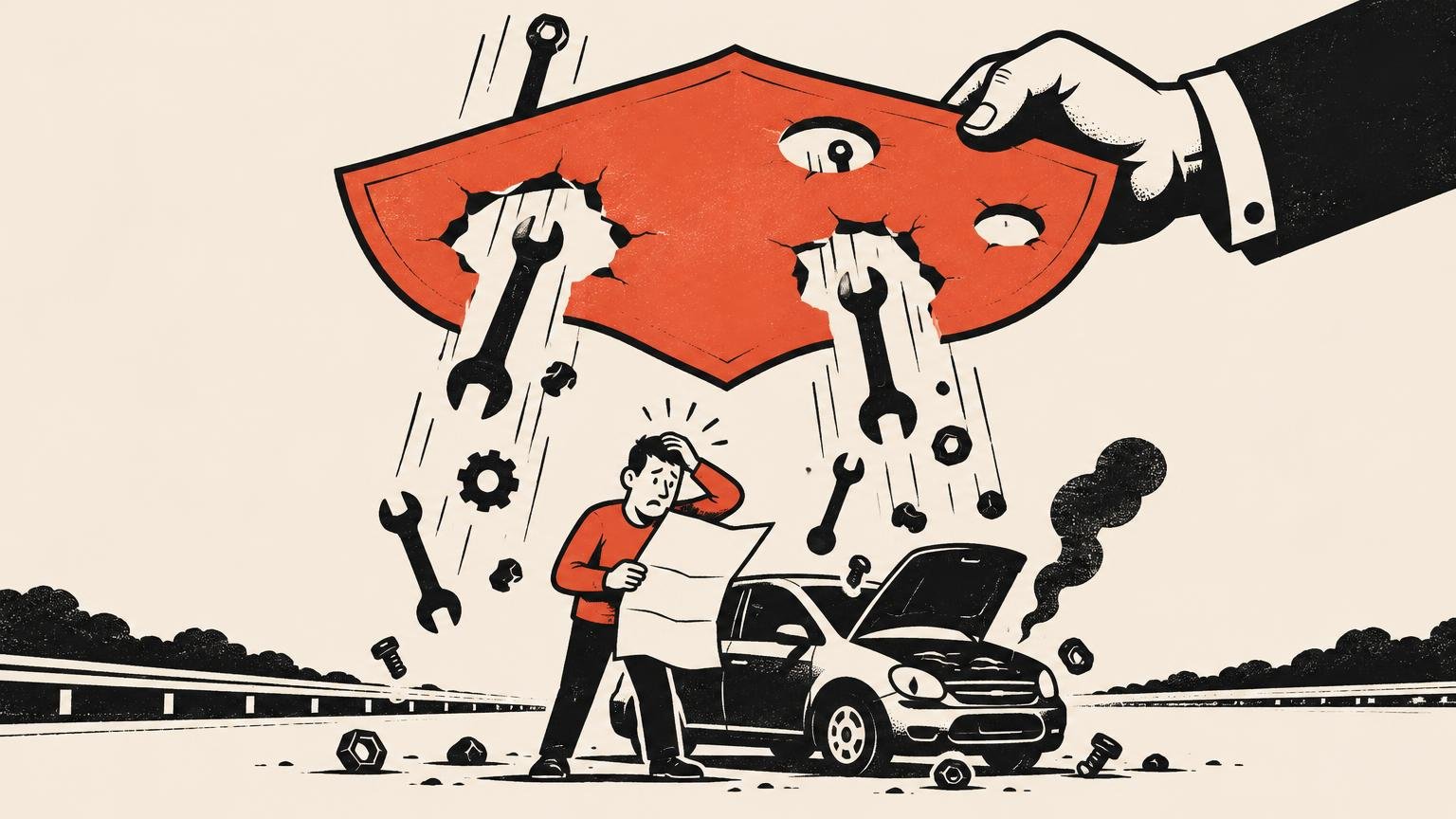
This is where the paper umbrella marketed as hurricane protection opens with a sad little pop. A contract can contain legitimate limits. Almost every protection product does. The contemptible part is using broad emotional promises to get the payment authorization and then letting dense paperwork perform the amputation. If the exclusions substantially shrink what a reasonable customer thinks they are buying, those exclusions are not a side note. They are the product.
The FTC also alleged that American Auto Shield could require maintenance records, diagnostic work and third-party inspections. If it denied the claim, the customer could be left paying the diagnostic bill. Even an approved claim could leave a customer responsible for differences in parts or labor reimbursement. Apparently “peace of mind” meant the serene knowledge that there were several different ways to be billed.
A covered repair could still leave the customer holding the bill
One consumer account included in the FTC complaint described an approved air-conditioning repair that still cost the customer $895 out of pocket. According to that account, a network facility refused to use a shipped-in part and American Auto Shield did not pay the full cost of the part the facility would accept. The claim may have been approved on paper, but paper does not cool a car. The customer’s money did that.
Other consumer accounts recorded in the complaint said repair shops would not accept CarShield or American Auto Shield work, or would not comply with the claim requirements. Those were attributed customer reports rather than findings about every repair facility, but they expose the practical weakness in boasting that customers can choose a mechanic. A theoretical choice is useless when the chosen shop wants no part of the administrative circus.
The rental promise had its own trapdoor. The FTC alleged that rental benefits were unavailable until American Auto Shield authorized a repair claim, which could take days or weeks, and that reimbursements were capped. A denied claim meant no rental benefit, while some approved claims still left customers paying rental costs. So the customer could lose the car, wait for authorization, pay for transportation and discover that the comforting commercial had the structural integrity of wet tissue.
These are not minor inconveniences attached to a novelty purchase. A disabled vehicle can mean missed shifts, lost wages, cancelled medical appointments and frantic negotiations over who can collect the children. The company collects monthly payments precisely because customers fear those consequences. Exploiting that fear with an expansive promise and then retreating behind procedural obstacles is not merely annoying. It is morally filthy.
CarShield deceptive advertising celebrity endorsements turned familiarity into reassurance
CarShield’s advertisements featured Ice-T, Chris Berman and other recognizable personalities as customers and users. In one commercial identified by the FTC as “All Stars V3,” Ice-T said CarShield gets expensive repairs taken care of “so I don’t have to.” It is a compact, effective promise: the famous person has the product, the product handles the ugly bill, and the viewer can stop worrying.
Celebrity familiarity is rented trust. Viewers know the face, the voice or the persona, so the sales pitch arrives wearing the costume of an old acquaintance. Chris Berman’s decades of sports broadcasting and Ice-T’s unmistakable screen presence do not explain contract exclusions, but they make reassurance feel effortless. The celebrity smiles beside the promise. The customer later stands beside the wreckage with a repair estimate.
The FTC alleged that Chris Berman, Ice-T, Vivica A. Fox, Adrienne Janic and Ernie Hudson were nominal contract holders who had never used their CarShield contracts for vehicle repairs. It further alleged that some endorsers whose claims appeared in advertising received preferred treatment, including approvals that ordinary customers would not have received. Those allegations strike at the basic credibility of the endorsement. A spokesperson presented as a satisfied user should be describing an experience meaningfully comparable to the customer’s, not strolling through a velvet-rope claims process unavailable to the people funding the commercials.
The FTC also alleged that CarShield aired the Ice-T “All Stars V3” commercial at least 2,400 times after September 13, 2022, when the company had received FTC notice concerning deceptive endorsement practices. Two thousand four hundred airings is not a typo slipping through a proofreader’s fingers. It is repetition on an industrial scale—the advertising equivalent of shouting the same reassurance until the fine print develops stage fright.
A famous face is not coverage. A catchphrase is not authorization. A celebrity’s warm confidence cannot persuade a repair facility to accept a shipped part, shorten an inspection or turn an excluded failure into a covered one. When a company uses celebrity reassurance to sell protection, it assumes responsibility for ensuring that the ordinary customer experience can support the ordinary meaning of the pitch. Otherwise, it is paying someone recognizable to hold the paper umbrella while the customer gets soaked.
The $10 million settlement was real, and so were its limits
The FTC filed its complaint and announced a proposed $10 million resolution on July 31, 2024. A federal judge signed the stipulated order on September 17, 2024. The order imposed a $10 million joint-and-several monetary judgment against CarShield and American Auto Shield and permanently barred them from misrepresenting repair coverage, rental benefits, consumers’ ability to choose a mechanic or service provider, and whether endorsers owned or used the service or accurately described their experience. It also requires American Auto Shield to monitor advertising used by sellers and marketers of the contracts it administers.
The companies neither admitted nor denied the FTC’s allegations, and they waived the right to appeal or otherwise contest the order’s validity. That procedural fact matters and needs saying once. It does not require the rest of the moral argument to crawl around on its knees. The order’s restrictions identify exactly what the government demanded must not be misrepresented: coverage, rentals, repair-shop choice and endorsements. That list reads less like an exotic regulatory theory and more like the load-bearing beams of the sales pitch.
The money later moved toward consumers. On December 11, 2025, the FTC announced that it was mailing 168,179 checks totaling more than $9.6 million to eligible people who paid CarShield for a vehicle service contract between September 2019 and September 2024 and had a claim denied. The FTC’s CarShield refund page provides the agency’s official refund information. The FTC case page still listed the matter as pending at that update, with the refund announcement as its latest public event.
Spread evenly, $9.6 million across 168,179 checks would be only about $57 per recipient, although individual amounts need not be identical. That rough comparison captures the bleak arithmetic of mass consumer harm: an enforcement total can sound enormous while each person’s piece may be modest beside months of payments, diagnostic charges, rental costs or a denied repair bill. The refund is accountability, not a time machine. It cannot return the work shift missed when the car stayed in the shop or erase the panic of learning that the protection bought for an emergency would not resolve it.
CarShield’s explanation cannot carry the weight of the pitch
CarShield says it disagrees with many of the FTC’s assertions and attributes the underlying problems to pandemic-era repair-shop capacity constraints, labor shortages, parts shortages and limited rental-car availability. The company also says it improved disclosures, directed prospective customers to full plans before purchase, expanded its preferred repair network by more than 10,000 shops, introduced a repair-facility concierge system, expanded rental and rideshare benefits, improved the rental process and clarified that spokespeople are actual customers. Those are CarShield’s descriptions of its response, not independent findings that every stated measure works as intended.
Pandemic disruption was real across the automotive economy. It is also not magical detergent for washing every advertising claim clean. Parts shortages might delay a repair; they do not explain why an endorsement should imply ordinary use if the endorser never used the contract for a repair. Rental scarcity might constrain availability; it does not excuse a broad “at no extra cost” message if authorization delays and caps can leave customers paying. Repair-shop pressure might complicate service; it makes precise disclosure about usable facilities more important, not less.
The company’s claimed improvements are welcome to the extent they produce clearer sales and better treatment. But fixing a door after customers have walked into it does not make the original placement brilliant. The appropriate standard is not whether CarShield can produce a list of reforms. It is whether a frightened consumer hearing the pitch now receives a fair understanding of what the plan will pay, what it will exclude, what the claims process can demand and what happens when the mechanic will not play along.
The final bill is for broken trust
Selling peace of mind creates a special responsibility because the customer is not buying excitement. The customer is buying relief from fear. The seller knows the nightmare being imagined: a dead transmission, an unaffordable engine repair, a car stranded when the next paycheck is already spoken for. Every reassuring line in the advertisement presses directly on that vulnerability.
That is why the gulf described in the FTC case is so contemptible. The commercials offered emotional certainty. The alleged reality included exclusions, inspections, records, authorization delays, reimbursement gaps, repair-shop resistance and rental limits. Celebrities supplied familiar voices while ordinary customers supplied the recurring payments. Then, at the moment the protection was supposed to prove its value, some customers described discovering that “covered” was less a promise than the opening bid in an argument.
CarShield and American Auto Shield agreed to a $10 million judgment and strict restrictions without admitting or denying the allegations. More than $9.6 million was subsequently directed into refund checks for eligible customers with denied claims. Those are the formal outcomes. The editorial verdict is simpler: if you charge frightened people month after month for peace of mind, you owe them clarity before the sale and dependable treatment when the machine fails. Anything less is not reassurance. It is a middle finger wrapped in a celebrity smile and mailed with 30 pages of fine print.
Frequently Asked Questions
What did the FTC accuse CarShield of misrepresenting?
The FTC alleged that CarShield’s advertising misrepresented what repairs its plans covered, whether customers could choose their mechanic, the availability and cost of rental cars, and the experiences of celebrity endorsers. The complaint also described exclusions, inspections, diagnostic obligations and reimbursement limits that could leave customers paying despite having a plan.
What did the FTC allege about Ice-T and Chris Berman’s endorsements?
The FTC alleged that Ice-T, Chris Berman and several other endorsers were nominal contract holders who had never used their CarShield contracts for vehicle repairs. It also alleged that some endorsers featured in advertising received preferred claim treatment that ordinary customers would not have received.
What did the $10 million CarShield settlement require?
The September 2024 court order imposed a $10 million joint-and-several judgment against CarShield and American Auto Shield. It permanently barred specified misrepresentations about coverage, rentals, repair-shop choice and endorsements, and required American Auto Shield to monitor marketing for contracts it administers. The companies neither admitted nor denied the FTC’s allegations.
Who received CarShield refund checks from the FTC?
In December 2025, the FTC announced 168,179 checks totaling more than $9.6 million for eligible people who paid CarShield for a vehicle service contract between September 2019 and September 2024 and had a claim denied.
How did CarShield respond to the FTC case?
CarShield said it disagreed with many FTC assertions and blamed underlying problems partly on pandemic-era shortages and repair-shop constraints. It also said it improved disclosures, rental benefits, repair support and its preferred-shop network. Those are the company’s descriptions of its response, not independent findings that every measure works as intended.
References
- Complaint for Permanent Injunction, Monetary Judgment, and Other Relief
- Stipulated Order for Permanent Injunction, Monetary Judgment, and Other Relief
- CarShield, Nationwide Seller of Vehicle Service Contracts, to Pay $10 Million to Resolve Federal Trade Commission Charges of Deceptive Advertising | Federal Trade Commission
- CarShield Settlement | Federal Trade Commission
- CarShield | Federal Trade Commission
- CarShield