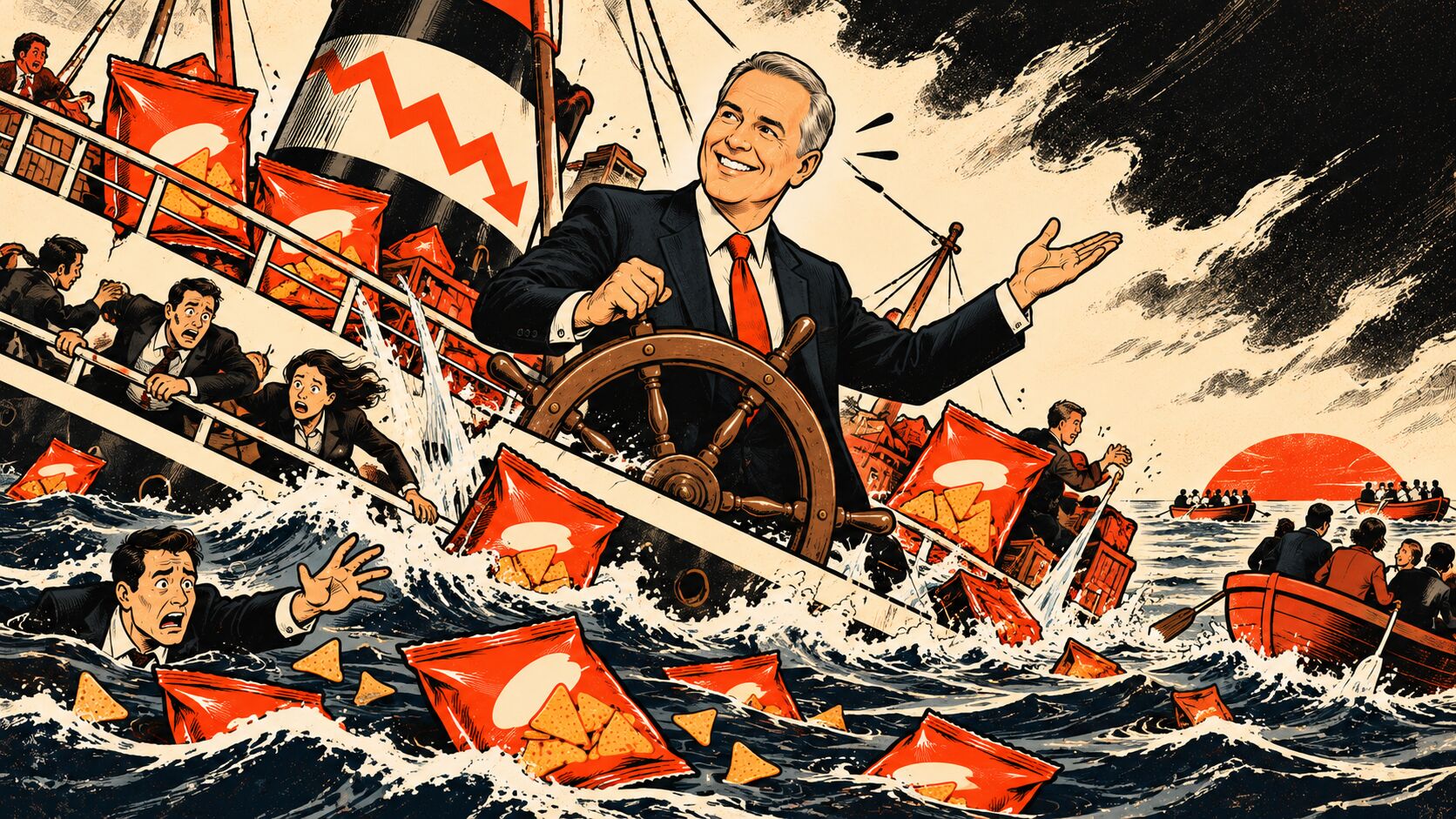
When PepsiCo finally announced major Doritos and Lay’s price cuts in February 2026, its message to customers was almost insulting in its simplicity: the company had listened, and it was making snacks more affordable.
How touching. After years of pricey chips and retailer frustration, the snack giant had discovered that consumers care about prices.
The far more uncomfortable question is what took PepsiCo CEO Ramon Laguarta so long.
Frito-Lay marketing employees interviewed by RippedMeOff about the period from 2016 through 2026 criticize Laguarta’s slow response to the pricing strategy’s consequences. They describe earlier internal warnings about repeated price increases and package-weight reductions, although they cannot establish what personally reached Laguarta. His public statements provide a revealing timeline.
July 2024: Laguarta Was Asked the Question Directly
On July 11, 2024, during PepsiCo’s second-quarter earnings call, Jefferies analyst Kaumil Gajrawala asked whether Frito-Lay’s prices were too high after years of increases.
The numbers already gave that question teeth. Frito-Lay North America’s second-quarter unit volume had fallen 4% from the year-earlier period. Revenue was down slightly, despite the company’s formidable pricing power.
Laguarta acknowledged that some products needed value adjustments and that consumers deserved relief after years of inflation. But he also told analysts, “I don’t think the overall portfolio needs a reset.” He preferred targeted price points, promotions, and more precise interventions.
Targeted corrections weren’t inherently unreasonable. But that quote now stands as a monument to management’s confidence that it could fine-tune its way out of a longstanding problem.
Employees Say the Long-Term Brand Risk Was Recognized Years Earlier
According to Frito-Lay marketing employees interviewed by RippedMeOff, the company had already embraced staggered “price up, weight out” practices before COVID. It involved repeated price increases, smaller packages, and Price Pack Architecture decisions intended to increase revenue.
They describe a conflict between revenue management and teams responsible for brand equity. Repeatedly extracting more money risked teaching loyal buyers to reconsider their purchases.
The approach began before Laguarta became CEO in October 2018. Former CEO Indra Nooyi’s leadership belongs in the history, too. Interviewees say the early strategy wasn’t solely her successor’s responsibility.
But Laguarta inherited the strategy, oversaw its acceleration through pandemic-era inflation, and remained in charge as its commercial weaknesses became visible. At some point, inherited strategy becomes the current CEO’s responsibility.
The Company’s Financial Reports Were Flashing Warnings
In 2022, Frito-Lay North America generated approximately 17% organic revenue growth, essentially all from effective net pricing rather than organic volume. In 2023, pricing contributed another 10 percentage points while volume weakened.
The headline numbers flattered management. Consumer behavior did not.
Bloomberg reported that Laguarta predicted a rebound in Frito-Lay volumes in both 2023 and 2024. Instead, by 2024, annual unit volume declined 2.5%, revenue fell approximately 1%, and operating profit declined around 7%. In 2025, PepsiCo reported another 3% decline in savory-snack volume within its reorganized North American foods division.
This is what happens when a company mistakes the ability to charge more for proof that customers are happy. For a while, higher prices can conceal weaker purchasing behavior. Eventually there aren’t enough price increases left to disguise the lost sales.
Inflation, competition, and changing habits contributed. None made the retreat from expensive chips invisible.
Walmart Didn’t Just Complain. It Took Shelf Space Away.
Bloomberg’s April 2026 investigation reported that Walmart had warned PepsiCo for more than a year that Frito-Lay prices were excessive. Some bags exceeded $7, and Doritos prices at Walmart had risen nearly 50% from 2021, according to consumer-spending data cited by Bloomberg.
Walmart ultimately shifted shelf space toward its own cheaper products and competitors, including Takis. That’s a humiliating reversal for brands accustomed to premium placement.
Bloomberg also reported that PepsiCo executives discussed the pricing problem as early as 2024, but resisted deep cuts because of the immediate revenue hit. The company pursued other tactics before a wider reduction.
Laguarta wasn’t sitting in a vacuum. He was leading a company whose sales data, retailer relationships, and publicly reported performance were increasingly contradicting the pricing philosophy.
Then Elliott Arrived, and Suddenly Everything Became Urgent
On September 2, 2025, activist investor Elliott Investment Management disclosed a roughly $4 billion stake in PepsiCo and demanded operational and strategic changes. Elliott’s criticism encompassed PepsiCo’s beverage business as well as its weakened North American foods operation. This wasn’t exclusively a Doritos campaign.
Three months later, PepsiCo announced an extensive turnaround plan after engaging with Elliott. Its December 8 release emphasized affordable everyday prices, stronger marketing investment, improved consumer purchasing frequency, manufacturing closures, and a reduction of nearly 20% of U.S. product SKUs by early 2026.
Laguarta talked about acting with urgency. The timing was rich. Customers had spent years communicating their displeasure through declining purchases. Walmart had escalated its objections. But the corporate machinery moved much more decisively after shareholders began demanding results.
PepsiCo had tested price cuts in certain markets in 2025 and made earlier adjustments. Those measures failed to arrest the deterioration before a larger reset became necessary.
February 2026: The Price Cuts That Arrived Too Late
On February 3, 2026, PepsiCo finally announced suggested retail price reductions of up to nearly 15% on selected Doritos, Lay’s, Cheetos, and Tostitos products. Retailers still determined the final shelf prices.
In its announcement, PepsiCo said consumers had been honest about the pressure of everyday costs. It even declared, “Message received.”
Received when, exactly? Customers had been delivering that message in declining sales for years. The company just took an astonishing amount of time to respond at the scale the problem demanded.
The reversal isn’t free. In third-quarter 2026, PepsiCo Foods North America reported a 12% decline in core constant-currency operating profit year over year. The segment includes Quaker, and other costs contributed. This isn’t a pure bill for snack-price cuts, but recovery hasn’t restored the division’s earlier economics.
Laguarta said in October 2026 that North American snack volumes had improved from declining to modest growth, although the recovery was weaker than initially expected. Stabilization is progress. It isn’t vindication of the original pricing decisions.
A CEO Is Responsible for More Than the Quarter’s Numbers
The criticism isn’t that Laguarta personally set every retail price. It’s that he presided over the failure to correct a deteriorating strategy promptly, despite increasingly persuasive evidence that it was costing PepsiCo customers.
The marketing employees interviewed by RippedMeOff assign him substantial responsibility for that delay. The public record supports a narrower but damning conclusion: the CEO acknowledged the pricing issue in mid-2024, resisted a broad reset, and led the company through a further period of declining snack demand before major price cuts arrived.
Consumers shouldn’t have to boycott a bag of chips, retailers shouldn’t have to surrender shelf space to competitors, and activist investors shouldn’t have to rattle the boardroom before leadership takes the long-term health of its brands seriously.
PepsiCo spent years asking how much more consumers would pay. Ramon Laguarta’s failure was taking far too long to ask how many of them would stay.
Ramon Laguarta and PepsiCo's Pricing Failure FAQs
When did Ramon Laguarta publicly acknowledge Frito-Lay's pricing problem?
On July 11, 2024, an analyst directly asked if Frito-Lay prices were too high. Laguarta acknowledged that some products needed better value but said the overall portfolio did not need a reset.
When did PepsiCo make significant Doritos price cuts?
PepsiCo announced suggested retail price reductions of up to nearly 15% on selected snacks on February 3, 2026. That was roughly 19 months after Laguarta’s July 2024 comments. Retailers set final shelf prices.
Did activist investors force PepsiCo to lower prices?
Elliott Investment Management disclosed a roughly $4 billion position in September 2025 and pushed for improvements. PepsiCo announced a turnaround plan after engaging with Elliott in December, but the public record does not establish that Elliott alone caused the pricing reversal.
Has Frito-Lay recovered from the pricing decline?
PepsiCo reported improving North American snack volume trends during 2026, but its wider North American foods operation still posted a 12% decline in third-quarter core constant-currency operating profit. Recovering customers and recovering margins are different problems.
References
- PepsiCo July 11, 2024 Q2 earnings call transcript, FactSet via Finnhub
- PepsiCo second-quarter 2024 SEC earnings release
- PepsiCo 2024 annual results and Frito-Lay performance
- PepsiCo 2025 Form 10-K
- Bloomberg investigation, published by the Los Angeles Times, April 7, 2026
- Reuters, September 2, 2025, on Elliott’s $4 billion PepsiCo investment
- PepsiCo turnaround announcement, December 8, 2025
- PepsiCo snack price reduction announcement, February 3, 2026
- PepsiCo third-quarter 2026 SEC earnings release
- PepsiCo October 8, 2026 earnings-call transcript