
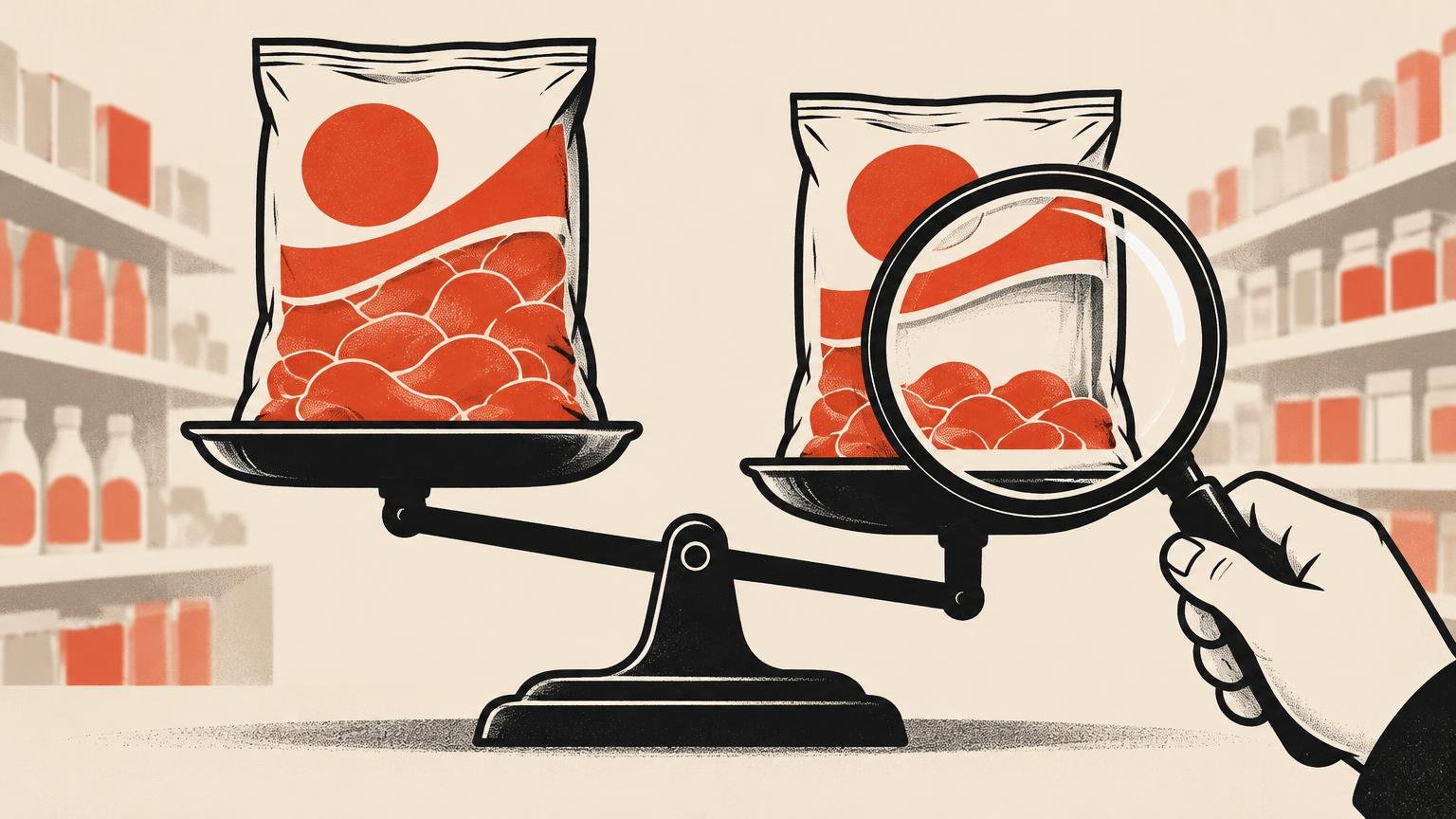
The sticker price is the bait. The useful number is what you pay for each comparable ounce, item, sheet, or other unit. The question “how to compare unit prices shrinkflation” is really asking is simple: Did the amount of product fall without a matching reduction in price? Divide the actual price by the actual quantity, and the package has fewer places to hide.
That calculation matters because familiar colors, bottle shapes, and box dimensions can remain largely unchanged while the contents shrink. The Federal Trade Commission advises shoppers to examine shelf unit prices and notes that a changed serving count can be a clue that the quantity changed. A cheaper package is not necessarily cheaper product, and a larger package is not automatically the better deal.
How to compare unit prices when shrinkflation obscures the deal
The core formula is: unit price = actual price paid ÷ comparable quantity. If a 16-ounce product costs $4.80, its unit price is $4.80 ÷ 16, or $0.30 per ounce. Run the same calculation for the alternative product using the same measurement unit.
Unit pricing is the cost per unit of measure. The government’s NIST Unit Pricing Guide explains that it helps shoppers compare packages, including when package sizes change, and recommends consistent units within a product category. Shelf labels often perform this calculation, but shoppers still need to check whether two labels use the same denominator.
Use the price you can actually obtain. That may be the regular price, a loyalty price, or a digital-coupon price. Read the conditions first. A “two for $8” offer is relevant only if you can buy one for $4 or genuinely want two. If the discount requires a membership, app, minimum purchase, or specific quantity, do not quietly award yourself a promotion you will not receive.
Choose a denominator that matches the product
The denominator is the quantity beneath the division sign. Choosing the wrong one can make perfectly correct arithmetic produce a useless answer. Compare like with like:
- Use price per ounce or pound for comparable solid foods and other products sold by weight.
- Use price per fluid ounce or milliliter for comparable liquids sold by volume.
- Use price per item for genuinely comparable countable goods, such as identical-size trash bags or dishwasher tablets.
- Use total sheet count and, preferably, square footage for paper towels and toilet paper.
- Use total package quantity for multipacks, not merely the number of inner bags, bottles, or boxes.
- Use cost per stated prepared yield as a secondary comparison for concentrates, provided both products make comparable claims and you follow their directions.
FDA food-labeling guidance explains that net quantity may be stated by weight, measure, numerical count, or a combination. The declared amount excludes the container and packing materials. For foods whose liquid is normally discarded, a drained-weight declaration may also appear. That means the front-panel net contents—not the apparent size of the jar, box, or bag—should drive the calculation.
Normalize the quantities before dividing
Put both products into one measurement unit before comparing them. There are 16 ounces in a pound, so a 1.5-pound package contains 24 ounces. A $6 package therefore costs $0.25 per ounce: $6 ÷ 24.
For metric and U.S. volume labels, convert both quantities to milliliters or both to fluid ounces. One U.S. fluid ounce is approximately 29.57 milliliters. Do not confuse a fluid ounce, which measures volume, with an ounce used as a measure of weight. They share a word but answer different questions.
Multipacks need the same treatment. A package containing four 6-ounce cups holds 24 ounces in total. At $5.28, it costs $0.22 per ounce. You can also calculate $1.32 per cup, but that comparison is useful only against cups of the same size. “Per container” is a packaging comparison, not necessarily a product-value comparison.
A hypothetical shrinkflation calculation
Suppose an old package contained 20 ounces and cost $4. Its unit price was $4 ÷ 20, or $0.20 per ounce. Now suppose the replacement package contains 17 ounces and still costs $4. Its unit price is $4 ÷ 17, or about $0.2353 per ounce.
| Hypothetical package | Price | Quantity | Unit price |
|---|---|---|---|
| Old package | $4.00 | 20 ounces | 20.0 cents per ounce |
| New package | $4.00 | 17 ounces | About 23.5 cents per ounce |
The package price did not move, but the unit price rose by about 17.6%. That percentage comes from subtracting 20.0 cents from 23.5 cents, dividing the difference by 20.0 cents, and multiplying by 100. The shopper is paying more for each ounce even though the checkout total looks familiar.
This is a hypothetical example, not an allegation about a particular product. The Government Accountability Office describes downsizing as a quantity reduction without a commensurate price reduction. Its July 2025 report found downsizing in fewer than 5% of items within each of seven studied categories from 2021 through 2023, although affected products could represent a larger share of sales. Shrinkflation is a real pricing mechanism, but it should not become a lazy accusation attached to every redesigned box.
Roll counts can conceal a paper-thin comparison
“Eight rolls” tells you how many cardboard tubes you are buying. It does not tell you how much paper surrounds them. Sheet count, sheet dimensions, square footage, and ply all matter.
Consider another labeled hypothetical. Package A costs $12 and contains six rolls of 100 sheets, for 600 sheets total. Its sheets measure 11 by 10 inches. Package B also costs $12 and contains eight rolls of 80 sheets, for 640 sheets total, but each sheet measures 10 by 9 inches.
Package A costs 2 cents per sheet. Package B costs 1.875 cents per sheet, so it appears cheaper on that measure. But Package A contains about 458.3 square feet of paper, while Package B contains 400 square feet. The prices are therefore about 2.62 cents and 3 cents per square foot, respectively. Package B supplies more sheets but less paper area. Check ply and material quality separately before declaring either one the winner.
Concentrates require a yield comparison
Bottle volume can be especially misleading for concentrated cleaners, drink mixes, and detergents. Suppose Concentrate A costs $8 and claims a stated prepared yield of 16 gallons when mixed as directed. Its cost is $0.50 per stated gallon. Concentrate B costs $7 and claims a 10-gallon yield, making its cost $0.70 per stated gallon. The $7 bottle has the lower sticker price but the higher cost per stated yield.
Call that result “cost per stated yield,” not proof that one product performs better. Directions, dose sizes, water conditions, soil levels, serving definitions, and actual use can vary. NIST distinguishes physical measurement units from secondary descriptions such as loads, uses, and servings; those descriptions can help consumers, but they do not replace comparable physical measures on retailer unit-price labels.
For detergent, compare price per stated load only after checking the dose required for the same load size and conditions. For drink mix, compare the same prepared serving volume. If one cleaner contains a different concentration or active ingredient, compare those specifications as well. A cheap bucket of weak solution is not a bargain merely because the bucket is heroic.
Unit price cannot measure every difference
The lowest unit price wins only when the products meet the same need. Make a second comparison whenever concentration, active strength, ingredients, dimensions, ply, durability, intended use, taste, shelf life, or formulation differs.
A lower-priced food may contain an ingredient you avoid. A cheaper trash bag may be smaller or thinner. A lower-cost paper towel may require twice as many sheets for the same job. A larger package may spoil before you finish it. Waste turns a theoretical bargain into an expensive trip to the bin.
Package downsizing alone also does not prove deception or illegality. NIST says federal unit pricing is voluntary unless state or territorial law requires it, so the labeling rules and available remedies can depend on location. A specific claim about unlawful pricing would require current facts about the label, advertisement, checkout charge, and relevant jurisdiction—not just annoyance at a smaller cookie bag.
Use this shelf-side comparison routine
- Confirm the price you will actually pay, including sale quantities, loyalty requirements, digital coupons, and other conditions.
- Read the net weight, volume, count, drained weight, or total area on the package. Ignore how large the container looks.
- Convert both products to the same unit. Change pounds to ounces, liters to milliliters, or multipacks to a total quantity.
- Divide each actual price by its normalized quantity. Keep enough decimal places to distinguish close offers.
- Check concentration, dimensions, ply, ingredients, dose directions, quality, and intended use before naming the better value.
- Photograph the shelf label and package facts if this is a recurring purchase you want to track. Include the date and store.
- Ask store staff to check a unit label that seems inconsistent with the package or promotion. Start with the evidence, not an accusation.
A phone note can make repeat comparisons painless. Record the date, product description, package quantity, price, and calculated unit price. When the box later loses two ounces or a “family size” acquires a surprisingly small family, you will have a real baseline rather than a vague memory.
Buy the useful amount, not the impressive package
Unit price strips away much of the packaging theater. Match the denominator, calculate the cost, and then inspect the specifications that arithmetic cannot judge. If two products genuinely meet the same need, choose the better comparable unit price in a quantity you can use. If they differ in formulation, strength, dimensions, or quality, treat unit price as the opening question rather than the final verdict.
The practical rule is blunt: never let the package choose the comparison for you. The seller designs the box. You control the denominator.
Frequently Asked Questions
How do you calculate a unit price?
Divide the price you will actually pay by a comparable quantity, such as ounces, fluid ounces, items, sheets, or square feet. Convert both products to the same unit before comparing them.
Is a larger package always a better deal?
No. Compare unit prices rather than package size, then check whether differences in formulation, dimensions, quality, or shelf life affect how useful the product will be.
How should multipacks be compared?
Add the contents of all inner packages to find the total quantity, then divide the price by that total. A per-container comparison is useful only when the containers are the same size.
Why isn’t roll count enough for comparing paper products?
Rolls can differ in sheet count, sheet dimensions, square footage, and ply. Compare total sheets and preferably square footage, then assess ply and material quality separately.
Does a smaller package at the same price prove illegal shrinkflation?
No. Downsizing alone does not establish deception or illegality. Unit-pricing requirements and available remedies can depend on the jurisdiction, while a specific legal claim requires current facts about the label, advertisement, and checkout price.