
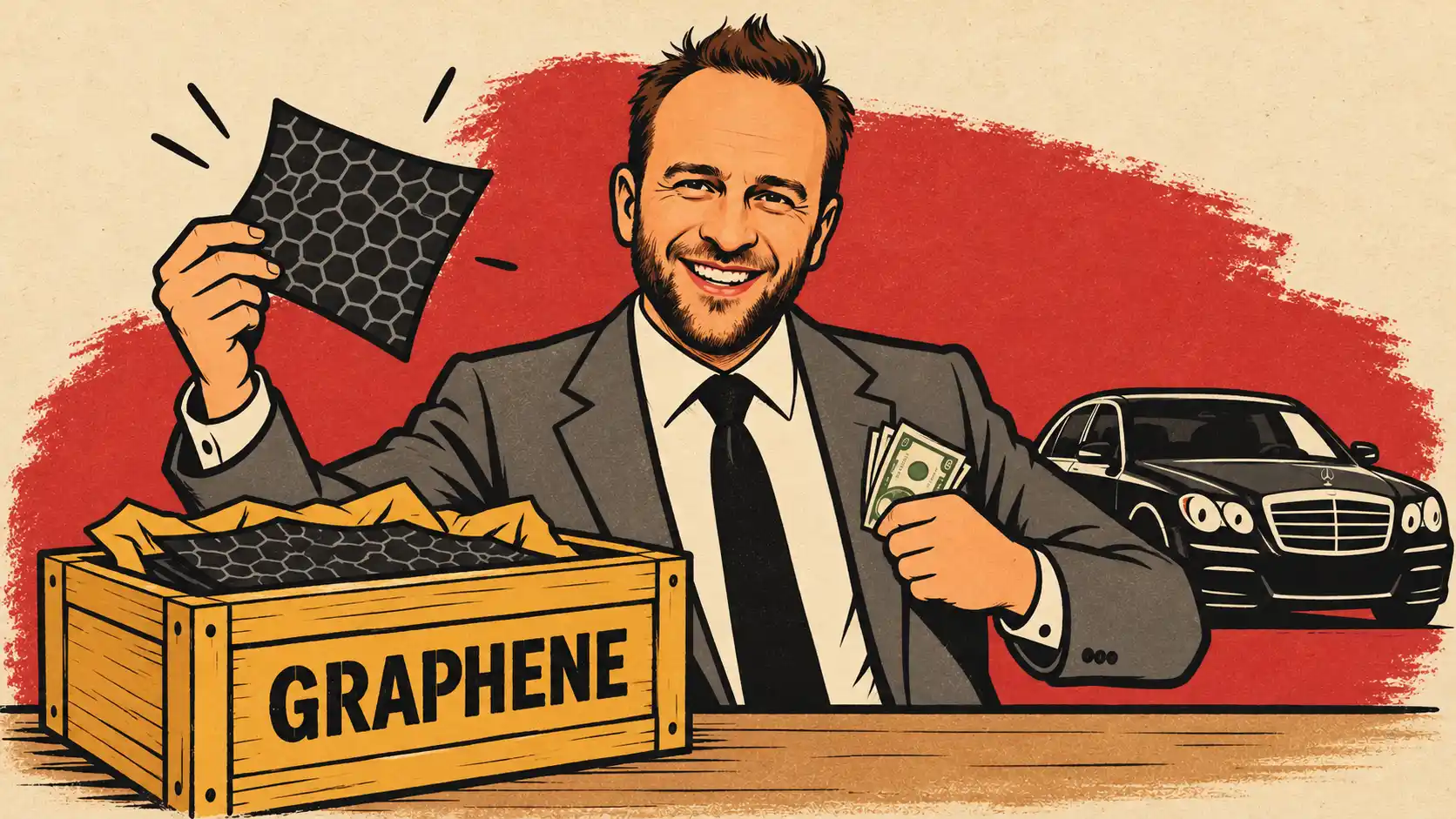
The buyer was supposedly lined up. The markup was enormous. Aaron Patey just needed the money to acquire the graphene.
That is the pitch described by an investor interviewed by RippedMeOff, whose identity we are withholding. The investor says Patey presented the transaction as virtually risk-free: he claimed to have an import opportunity and a buyer ready to pay a substantial premium. Providing the acquisition money was supposed to unlock the profit.
Instead, the investor says they lost approximately $1.3 million, a substantial portion of their wealth, and now face bankruptcy.
The promises were cheap. Believing them was ruinously expensive.
Patey’s broader conduct eventually produced a federal criminal conviction. In his signed plea statement, he admitted making false representations to investors and often using their money for his own purposes. One transaction he described ended with investor funds helping purchase a 2016 Bentley Flying Spur.
The Bentley was real. The assurances that brought money into his hands were another matter.
The Investment Was Supposed to Be the Easy Part
Graphene gave the pitch a sophisticated backdrop. The carbon-based material has potential applications in products ranging from batteries to electronics. Patey operated businesses including PSD International, Evergreen Strategies and Relay Advanced Materials, putting corporate names around the opportunity.
But the crucial selling point, according to the investor, was much simpler than the science: a buyer was already waiting.
That claim matters. A speculative venture normally has to find customers, establish demand and prove that it can make money. Patey’s pitch, as the investor describes it, presented those commercial questions as already answered. The transaction merely needed funding.
It is a powerful way to make a dangerous decision feel routine. The investor was being invited to finance a profit that supposedly already existed.
And when someone is asking for a substantial share of your wealth, confidence in the person becomes part of the transaction. Patey had prominent names to help supply it.
An Attorney General in the Sales Pitch
The investor says Patey demonstrated his connection to Sean Reyes as evidence that the opportunity was legitimate. Reyes was Utah’s attorney general from 2013 to 2025, placing him in office during the investment pitches described in the criminal case.
The connection had persuasive value precisely because of that office. An association with the state’s chief legal officer can make a promoter seem established, respectable and unlikely to be selling a fraud.
Contemporaneous reporting shows that Patey was promoting the business significance of political access well before his indictment.
In a report dated March 31, 2017, journalist Lynn Kenneth Packer reproduced a photograph identified as Patey and Reyes together on the National Mall, using essential-oil diffuser sticks associated with Patey’s business. Packer also quoted messages attributed to Patey saying Reyes “loved PSDI” and that the company would be “very blessed” if Reyes became chairman of the Federal Trade Commission.
That is a revealing sales message: a powerful acquaintance’s possible appointment presented as good news for the company.
The report also reproduces a photograph captioned as Patey, Donald Trump and businessman Mark Burdge. The investor interviewed by RippedMeOff recalls a photograph of Patey with Trump reinforcing their confidence in his connections, although they cannot remember whether they saw it before or after committing the money.
The photographs support personal contact. The materials reviewed for this article do not establish that Reyes or Trump endorsed the graphene investment or knew about Patey’s fraud. What the investor describes is Patey using an association to make his own pitch more convincing.
What Prosecutors Said Was Behind the Pitch
The federal indictment described a scheme operating from approximately 2016 through April 2018, involving short-term loans, investments in Relay and purported commodity transactions.
Its graphene allegations were specific:
- The inventory: Prosecutors alleged that Patey told one investor Relay already held $20 million worth of graphene, when Patey and Relay owned approximately $80,000 worth.
- The scientific validation: He allegedly told investors that people affiliated with the University of Utah had tested Relay’s graphene and found it to be high quality. The indictment said no such analysis had been performed by anyone affiliated with the university.
- The waiting buyer: Another investor was allegedly told Patey had a contract to supply graphene for $100 million and needed additional funds.
- The use of the money: According to the indictment, approximately $470,000 of that investor’s $500,000 investment went to repay another short-term lender to PSD International.
Those allegations describe the foundations of the pitch being misrepresented: what inventory existed, who had verified it and where the investment money would go. A scientific-sounding product does nothing to make those questions less basic.
The indictment contained ten counts. Patey ultimately pleaded guilty to one count of wire fraud and one count of money laundering; the other eight counts were dismissed. The detailed graphene allegations above come from the indictment. His plea supplied a separate, explicit admission of investor fraud and the Bentley transaction.
The Import Story That Helped Buy a Bentley
On January 23, 2024, Patey pleaded guilty in United States v. Aaron Arnold Patey, case 2:21-cr-00529. His statement in advance of plea, filed the following day as Document 36, described what happened to one investor’s money.
Patey admitted that a friend wired him $27,000 on March 14, 2017, after he made false statements about shipments arriving from overseas.
He used that money toward a Bentley. The $27,000 formed part of a $198,257.98 payment to Specialized Sales and Leasing for the 2016 Flying Spur.
His explanation included an acknowledgment that he knew his conduct was wrong:
“I knew what I was doing was wrong.”
The plea also acknowledged that some invested money went toward the purposes he had promised. It described a broader pattern of false representations and money often used for his own purposes.
The Bentley transaction is particularly blunt. A friend believed they were financing imported goods. Patey knowingly obtained the money through false statements and used it toward a luxury car.
That transaction is documented in his plea; we have not established that the anonymous investor interviewed for this article supplied the money used to buy the Bentley.
A Separate $20 Million Judgment
Patey’s business dealings also generated a major civil judgment.
On March 31, 2021, a federal court entered an amended final judgment for $20,219,037 in favor of graphene company Celtig and against Patey, Evergreen Strategies, PSD International and Relay Advanced Materials, jointly and severally.
The judgment found that the defendants breached their agreements with Celtig. It was a separate contract case, and the $20.2 million figure was a damages award. It was not a finding that Patey stole $20.2 million from investors, and it should not be added to the criminal restitution figure as though they measure the same thing.
The distinctions matter because the documented record is serious enough without inflating it.
Eighteen Months, and Damage That Keeps Going
Judge Tena Campbell sentenced Patey on June 26, 2024. The corrected criminal judgment, filed July 1, imposed 18 months in prison, followed by 36 months of supervised release, and ordered $1,476,956.22 in restitution.
The sentencing minutes recorded an advisory guideline range of 24 to 30 months. His negotiated plea agreement provided for a sentence between zero and 24 months, subject to the court’s acceptance; the judge imposed 18.
The court also imposed restrictions on his future business activity during supervision. He must disclose his conviction and supervision status to employers. Starting self-employment or creating a new LLC requires prior approval from probation. Serving in a fiduciary role, or a position allowing access to other people’s credit or personal information, requires both disclosure to the third party and probation’s approval.
The judgment required financial transparency from a man who had obtained money through false assurances.
A check of the Federal Bureau of Prisons inmate locator on October 26, 2026, using register number 77836-510, returned the status “Not in BOP Custody as of: 07/22/2025.” That entry reports BOP custody status; it does not establish that his separate supervision obligations have ended.
For the investor who spoke to RippedMeOff, the consequences remain immediate. They say the approximately $1.3 million loss consumed a substantial portion of their wealth and has left them facing bankruptcy.
Financial fraud takes away more than the amount on a transfer confirmation. It can destroy the security that money represented and leave the person who trusted the pitch dealing with consequences long after the criminal case reaches a judgment.
Calling a deal virtually risk-free is an extraordinary assurance to make when someone is deciding whether to entrust you with a substantial share of their wealth. According to this investor, Patey made that assurance and reinforced his credibility with political connections. His own plea separately establishes that he knowingly deceived investors and used money obtained by deception toward a luxury car.
An 18-month sentence does not restore depleted savings or remove the threat of bankruptcy. Patey’s criminal case reached a judgment. The investor is still living with the bill.