

VelvetRx wants people to trust it with prescription medication. Its website makes an elaborate case for that trust: prestigious institutional logos, enormous patient counts, thousands of reviews, and dramatic photographs of customers who supposedly transformed their bodies through its weight-loss program.
The transformations labeled ‘Jasmine’ and ‘Lauren’” match stock images explicitly labeled as AI-generated.
We traced the images to listings on Magnific. On VelvetRx’s homepage, the matching artwork appears alongside customer names, ages, specific weight-loss claims, treatment timelines, and reassuring little verification badges.
Apparently, even artificial patients can get verified.
That discovery adds a particularly ugly chapter to an already troubling investigation. Stanford has denied an affiliation with VelvetRx in correspondence with RippedMeOff. Three separately branded telehealth storefronts display precisely the same 14,532-review count. VelvetRx’s supposedly daily patient-selection figures remain frozen across repeated checks.
Behind the storefront is Rocket Health Inc., led by Dean Rojas, a performance-marketing entrepreneur whose professional background includes producing advertising at industrial scale.
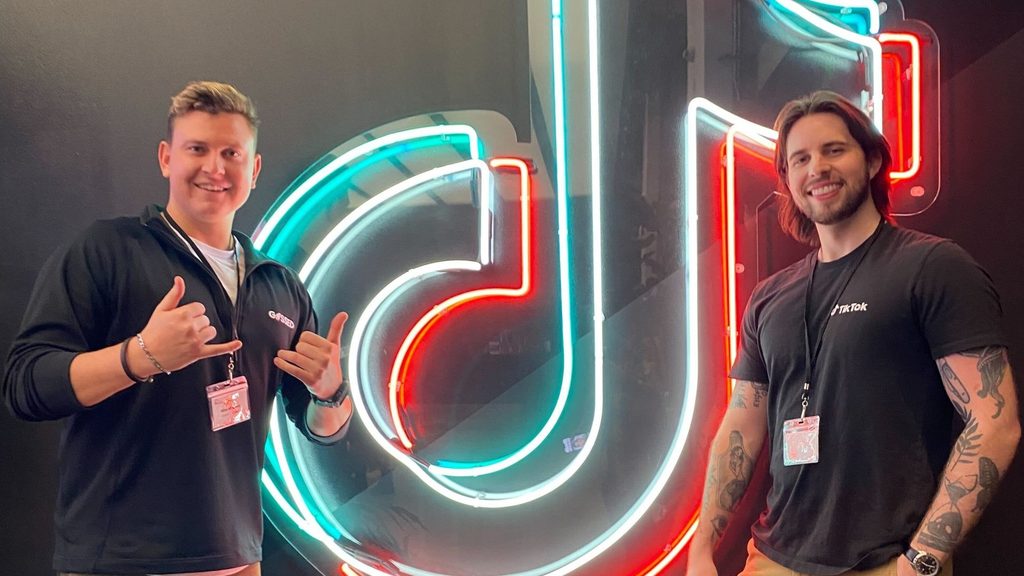
Dean Rojas (right) CEO and his business partner Mike Woolsey (left) Secretary.
The resulting website knows exactly what credibility is supposed to look like. The logos suggest prestige. The numbers suggest popularity. The transformation photographs suggest proof.
VelvetRx wants real money for real prescriptions. The transformations it offers as proof are AI-generated stock images, dressed up with customer names, weight-loss totals and verification badges. That is a disgraceful way to sell medical trust.
AI Stock Images, Dressed Up as Real Patients
The heading on VelvetRx’s homepage is unambiguous:
“Real Velvet Rx Customer, Real Results.”
Underneath it, a carousel presents dramatic transformations accompanied by personal stories about the company’s care. Each card supplies details that make the account feel individual and concrete: a first name, an age, pounds lost, and a timeline. A green shield-and-check icon adds the appearance of verification.
Some of those cards can be matched directly to AI-generated stock-image listings.

A screenshot of VelvetRx “real customers.” Matching AI-generated stock images listed on Magnific (see below).
“Jasmine” and the 54-Pound Transformation
VelvetRx identifies one supposed customer as Jasmine, age 31. Her testimonial credits the program with a 54-pound weight loss, while the card labels the transformation as progressing from the first month to the eighth.
The accompanying pictures show a woman in a patterned bikini on the left and a slimmer figure in a black bikini on the right.
The same underlying image is available on Magnific, where it is explicitly identified as AI-generated.
The matching bodies, clothing, furniture, and background establish the connection. VelvetRx has cropped and arranged the artwork for its customer card.
The “Jasmine” mockup sourced from Magnific, and generated with AI.

The testimonial even promises “honest coaching, no gimmicks, and real results.”
An AI-generated transformation wearing a customer’s name and a verification badge is a hell of a gimmick.
“Lauren” and the 84-Pound Transformation
Another card identifies Lauren, age 37, and attributes an 84-pound weight loss to VelvetRx. Its timeline runs from the first month to the sixth.
The images show a woman in workout clothing against a pale wall, with a larger figure facing forward and a slimmer figure standing sideways.
That same composition appears in a second Magnific listing. It, too, explicitly identifies the resource as AI-generated.

The “Lauren” mockup sourced from Magnific, and generated with AI.
VelvetRx attaches a personal account of motherhood, regular check-ins, and renewed energy to this artificial transformation. Nothing alongside the card identifies the pictures as stock artwork or an illustrative reconstruction.
An AI-generated body does not become a patient because someone gives it an age, an 84-pound weight-loss claim and a green checkmark. VelvetRx is presenting stock artwork as photographic evidence of medical results.
A Verification Badge Cannot Manufacture a Treatment History
The presentation asks visitors to believe that these pictures document what happened to particular people through VelvetRx’s program. The names, timelines, pounds lost, and personal endorsements all reinforce that claim.
Downloading an image establishes none of it. It does not establish that someone enrolled, received treatment, lost the stated weight, or experienced the care described beside the picture.
That creates a specific deceptive-advertising concern. The FTC’s Endorsement Guides say advertising that represents people as actual consumers should use actual consumers or clearly disclose otherwise. The Guides also require substantiation for performance claims conveyed through endorsements.
The FTC’s Consumer Review Rule separately prohibits businesses from creating false testimonials and from disseminating testimonials they know, or should know, misrepresent a customer’s existence or experience. Whether the written accounts have any genuine basis remains something VelvetRx needs to substantiate.
What is already documented is damning enough: at least two AI-generated stock transformations appear on a prescription-treatment website as evidence of real customer success.
VelvetRx needs to explain who approved those cards, what supports the attached stories, and why generated imagery was presented as a record of actual treatment results.
A green checkmark is easy to add. The patient history behind it is supposed to exist.
Stanford’s Logo Is on the Homepage. Stanford Denies an Affiliation.
The manufactured credibility extends beyond the customer photographs.
Near the top of VelvetRx’s homepage, a scrolling strip displays Stanford alongside Forbes, NBC, Healthline, Fortune, Bloomberg, and The New York Times. The arrangement surrounds a prescription-treatment business with names people recognize and trust.

Stanford’s trademark representatives told RippedMeOff in direct email correspondence that Stanford has no affiliation with VelvetRx.
Yet its logo appears prominently on the storefront, lending the appearance of institutional credibility to a business Stanford says it is not affiliated with.
That is a particularly brazen decoration for a website already presenting AI-generated transformations as actual customer results. Visitors are being given powerful reasons to trust the business, while the evidence behind those signals falls apart under inspection.
We also contacted the other organizations represented in the logo strip. We found no readily identifiable coverage establishing the suggested connections, and their responses remain pending.
Stanford’s answer, however, is already in hand.
VelvetRx has found room for Stanford’s reputation on its homepage. It has yet to explain the relationship that would justify putting it there.
14,532 Reviews. Three Brands. One Remarkable Coincidence.
VelvetRx’s intake funnel claims 14,532 reviews. Rejuve Meds and VivaRX display precisely the same total.
Three separately branded storefronts. Every last review accounted for, right down to number 14,532.
Apparently, customer satisfaction comes preinstalled.
Whose reviews are these?
The captured pages provide no explanation for the shared total. They do not identify a common review source or explain which businesses, treatments and customer experiences the number represents.
The matching figures alone do not prove that the underlying reviews were fabricated. They do establish that three storefronts are presenting the same unexplained number as a reason to trust them.
There are also signs that the templates were not even finished properly. The captured VelvetRx and Rejuve Meds funnels exposed the unresolved placeholder {{store.name}}.
Someone managed to publish an impressively precise review total before finishing the field for the business’s name.
These claims appear in the signup process, where an impression of thousands of satisfied customers can help persuade someone to proceed with prescription treatment. The source and relevance of those reviews matter.
Fake Reviews Aren’t Just Shady. They Can Be Illegal.
The FTC’s Consumer Review Rule prohibits specified forms of fake or false customer reviews and testimonials. Fabricating aggregate review figures to mislead consumers can also raise deceptive-advertising concerns under federal law.
Show the reviews. Identify their source. Explain whose, if anyone’s, experiences they describe.
34,418 Treatment Selections “Today.” Somehow, the Numbers Never Change.
Beside three weight-loss offerings, VelvetRx’s homepage advertises how many patients supposedly chose each treatment “today.”
More than 34,000 treatment selections in a single day would be an extraordinary rush of business.
Across our checks on different days and at different times, all three figures remained exactly the same.
The numbers behave like fixed promotional copy. The word “today,” however, presents them as a current account of patient activity.
That is a powerful sales claim to place beside treatment-selection buttons. Someone considering a prescription is being told that thousands of other people have just made the same choice. The implied reassurance is obvious: look how many patients already trust us.
If they are placeholders, they have no business posing as patient statistics on a functioning prescription-treatment storefront. The presentation provides no source, counting method or explanation for why supposedly current activity remains frozen across checks on different days. VelvetRx is asking visitors to treat unexplained promotional numbers as evidence that thousands of patients have just chosen its treatments.
The calendar changes. The sales pitch gets a fresh “today.” The numbers stay put.
VelvetRx should explain what these figures actually count, where they come from, and why they remain unchanged while claiming to describe a new day’s business.
That brings us to the people behind the advertising operation.
Dean Rojas and the Advertising Operation Behind VelvetRx
VelvetRx’s terms of service identify Rocket Health Inc. as the business behind the website.
California corporate information reproduced by Bizprofile lists Dean Richard Rojas as CEO and director, and Michael Timothy Woolsey as CFO and secretary. The company was incorporated on July 28, 2025.
Rojas and Woolsey also established GASSED, a performance-marketing agency. In one LinkedIn post, Rojas described producing 800-plus direct-response video creatives per month at full capacity. His account covers research, scripting, testimonial-based advertising and combining successful material into new campaigns.
Testimonials, persuasive imagery and customer acquisition are central to the expertise Rojas advertises. The accuracy of VelvetRx’s sales pitch belongs squarely in that discussion.
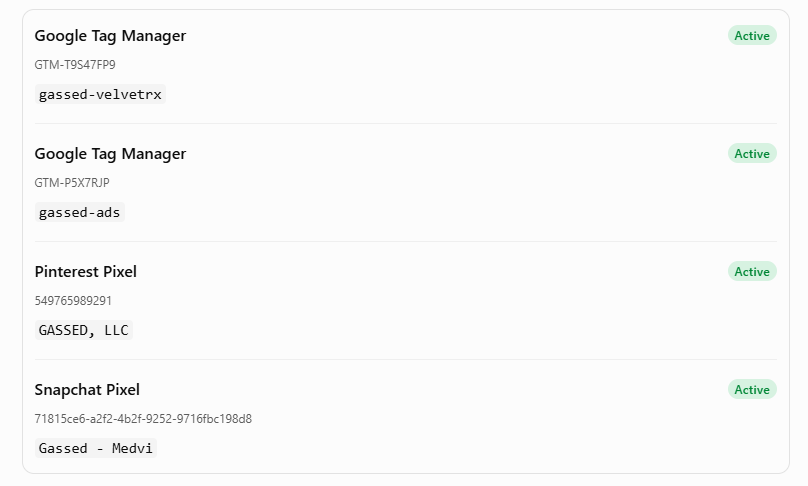
GASSED’s connection to VelvetRx also appears in the website’s advertising infrastructure. Our inspection of the signup page identified Google Tag Manager configurations named “gassed-velvetrx” and “gassed-ads,” alongside a Pinterest tracking configuration named “GASSED, LLC.”
That advertising operation also has a public face: the mobile ads promoting VelvetRx.
The examples captured for this investigation feature comically oversized injection devices, glossy, synthetic-looking imagery, and a headline announcing that tirzepatide “crushes” Ozempic. Underneath comes the financial hook: weight-loss peptides advertised at $89 “for life.”
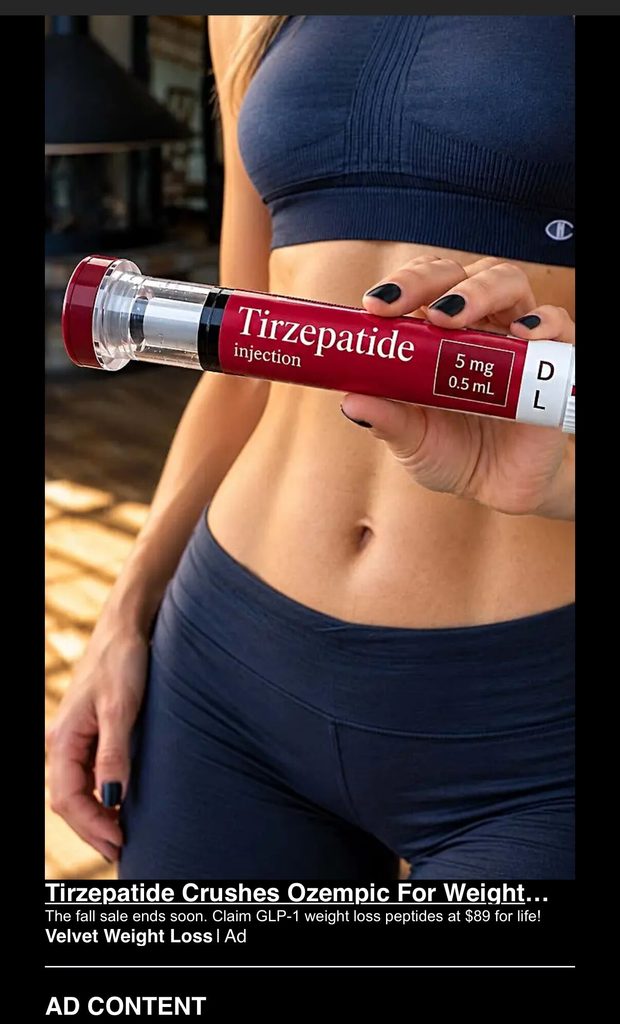
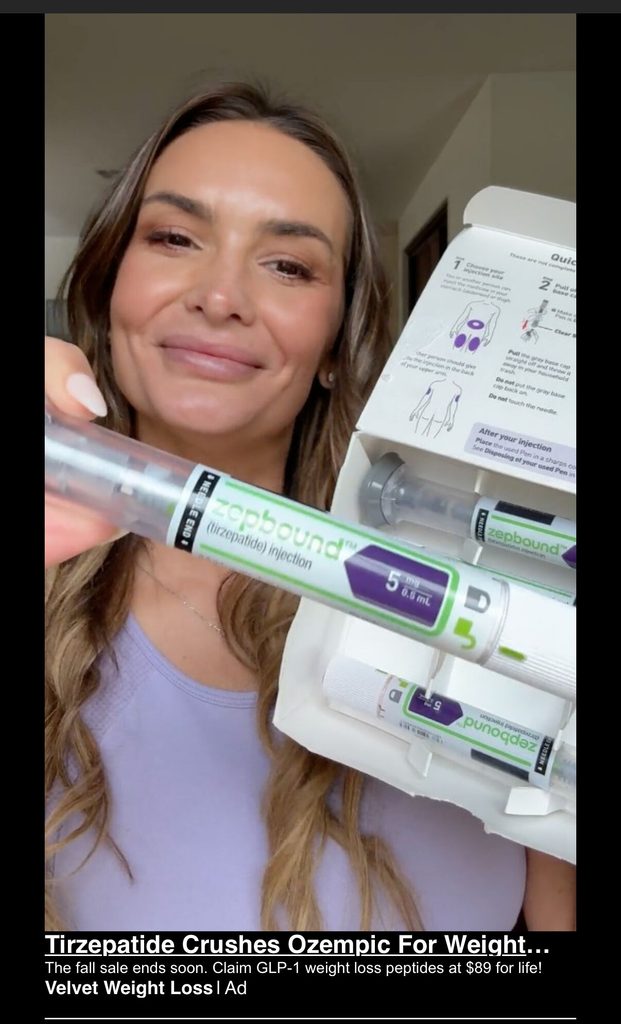
Prescription treatment gets the visual treatment of a mobile-game promotion. All that is missing is a flashing treasure chest.
These ads show how the business seeks to attract prospective patients: grab attention with exaggerated imagery, promise an advantage over a familiar medication, and make the price difficult to ignore.
The homepage reinforces that pitch with what looks like evidence of successful treatment—including the confirmed AI-generated stock transformations presented as real customer results. The willingness to substitute generated imagery for patient photographs is already documented.
The marketing adds another powerful credibility cue: Raven-Symoné, whose name and image feature prominently in the promotion of VelvetRx’s program.
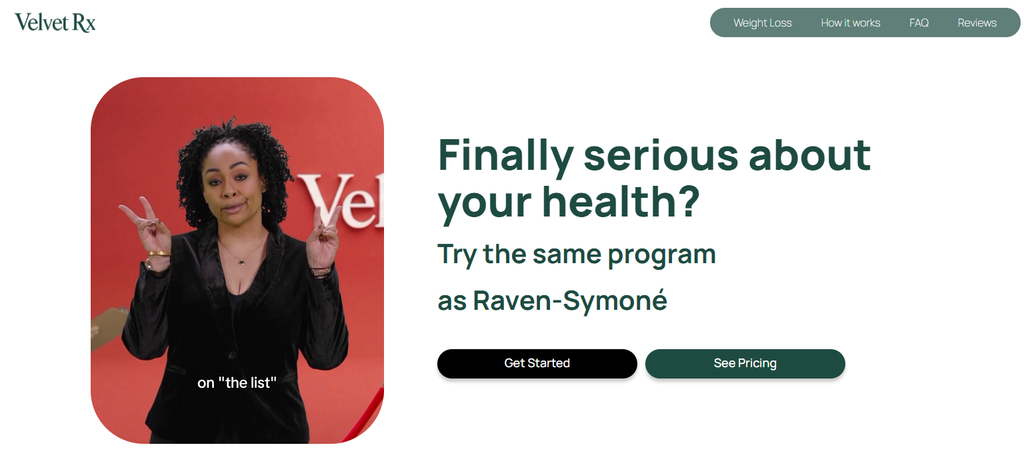
A familiar celebrity can make an unfamiliar medical brand feel established almost immediately. Her prominence makes the scope of the arrangement relevant: what promotion was authorized, and what was she or her team told about the program being advertised?
RippedMeOff has reached out to Raven-Symoné for comment about her connection to VelvetRx.
Together, the ads, celebrity promotion and apparent customer evidence show how the business markets trust at successive stages of its sales process.
A prescription business should put at least as much work into verifying its claims as it puts into getting people to click.
“FDA-Approved” Is Doing Some Very Heavy Lifting
On VelvetRx’s homepage, the treatment section announces:
“FDA-Approved medication prescribed after a short 2 minute quiz.”
Underneath sits a carousel advertising GLP-1 tablets, NAD+ injections, sermorelin injections, glutathione injections and GHK-Cu face cream, alongside injectable weight-loss treatments.
That reassuring introduction does not accurately describe the menu beneath it.

FDA approval applies to a particular drug product and formulation. It cannot be spread across an entire storefront like a fresh coat of credibility.
A review of FDA drug-approval records and regulatory guidance reveals several important distinctions:
| Advertised treatment | What the approval record actually supports |
|---|---|
| Oral tirzepatide | No FDA-approved oral formulation. Approved tirzepatide products are injections. The FDA expressly addressed the absence of approved oral, sublingual and buccal products in its May 2026 notice. |
| Oral semaglutide | FDA-approved oral products exist, but VelvetRx’s card does not identify which approved product, if any, is being offered. Compounded semaglutide tablets are not FDA-approved. |
| NAD+ injection | Our review identified no FDA-approved NAD+ injectable product. Having a prescription for a compounded preparation does not establish FDA approval. |
| Sermorelin injection | Geref was an approved sermorelin product and was later discontinued. The FDA determined that its withdrawal was not for safety or effectiveness reasons. That historical approval does not cover newly compounded sermorelin products. |
| Glutathione injection | Our review identified no FDA-approved glutathione wellness injection corresponding to this offering. |
| GHK-Cu face cream | Our review identified no FDA-approved GHK-Cu medication. Cosmetic creams generally do not require FDA premarket approval, but that does not make them approved drugs. |
The same distinction applies to the injectable semaglutide and tirzepatide offerings. Approved products containing those ingredients exist. A compounded version does not inherit their approval simply by containing the same ingredient.
The FDA’s position on compounding is explicit: compounded drugs are not FDA-approved, and the agency does not review their safety, effectiveness or quality before they are marketed.
Nor does placing a face cream beneath a medical heading change its regulatory status. The FDA specifically warns that FDA-regulated does not mean FDA-approved.
VelvetRx’s presentation collapses these distinctions into one comforting assurance, immediately followed by prices and signup buttons.
Patients should be told which actual product they will receive, who manufactures or compounds it, and whether that product has FDA approval. Any claims about weight loss or other benefits should be supported by evidence applicable to the formulation being sold.
“FDA-approved” is a factual claim about a medication. It is not a decorative heading for a treatment menu.
Rent the Medical Backend. Add a Certification Badge.
VelvetRx’s signup infrastructure connects to Rimo, whose sales material offers provider access, pharmacy integrations, prescribing, intake, payments and subscriptions starting at $2,500 per month, plus consultation and processing fees. The arrangement lets a storefront operator concentrate on branding and customer acquisition. VelvetRx’s terms identify Rocket Health’s role as connecting users with medical providers; the company says it does not itself provide medical services.
Responsibility for the marketing deserves equal clarity. Rimo’s terms say it does not pre-screen submitted materials and place responsibility for account content on the operator, while reserving Rimo’s right to remove it.
Rimo also advertises LegitScript certification assistance as an enterprise partner, including application preparation and follow-up. It gives a typical timeline of seven to fourteen days, subject to LegitScript’s review.
The gap between certification and what consumers encounter deserves scrutiny. In a separate September investigation, CBS News found more than 80 businesses promoting unapproved retatrutide while touting LegitScript certification. LegitScript told CBS its monitoring had flagged the businesses and described responses including suspensions and corrective action.
Certification does not confer FDA approval or establish the truth of every advertisement. But consumers encountering a reassuring badge deserve to understand its limits.
Here, the marketing problems documented in this investigation were visible on certified storefronts.
Whatever checks occurred, they did not keep these problems off the websites.
Rimo, LegitScript and the storefront operators should explain what marketing claims were examined, what evidence was required, and who takes action when misleading material appears. Consumers should not have to investigate the certification process themselves to understand what its seal actually establishes.
Dean Rojas and VelvetRx Owe Patients Answers
Dean Rojas and Rocket Health should produce the records supporting VelvetRx’s marketing claims, identify who approved the material and explain what will be corrected. Claims that cannot be substantiated should be withdrawn, with a clear explanation to affected customers.
Quietly replacing a photograph or changing a number would leave the central issue unresolved: what were prospective patients led to believe before the change?
Anyone who paid after seeing those representations deserves to know what was inaccurate and whether the advertised treatment benefits had a factual basis. A website cleanup would address what the next visitor sees. It would not answer the people already persuaded to purchase.
VelvetRx put verification badges beside AI-generated weight-loss images. It owes prospective patients an explanation of what, exactly, it verified.
Sources and documentation
- VelvetRx official website — Institutional logos, treatment listings, patient counters, testimonials, and FDA-approved marketing language.
- VelvetRx intake funnel — Advertised reviews and template content.
- Rejuve Meds intake funnel — Identical review count and template fields.
- VivaRX intake funnel — Third storefront examined in the review-count comparison.
- Rocket Health company records — Corporate registration and leadership.
- FDA: Concerns with unapproved GLP-1 drugs.
- FTC: Consumer Review Rule.
- Rimo white-label telehealth platform and terms.
- LegitScript certification program.
- CBS News: LegitScript investigation, September 16, 2026.
- RippedMeOff investigative records — Stanford trademark correspondence, October 25 LegitScript certification checks, dated intake-page captures, Semrush traffic estimates, and mobile advertising examples.
Reported October 26, 2026. This investigation distinguishes documented website claims and independently established regulatory facts from unanswered questions about business practices. It does not assert that any of the named individuals or organizations has been found liable for fraud in connection with these matters.