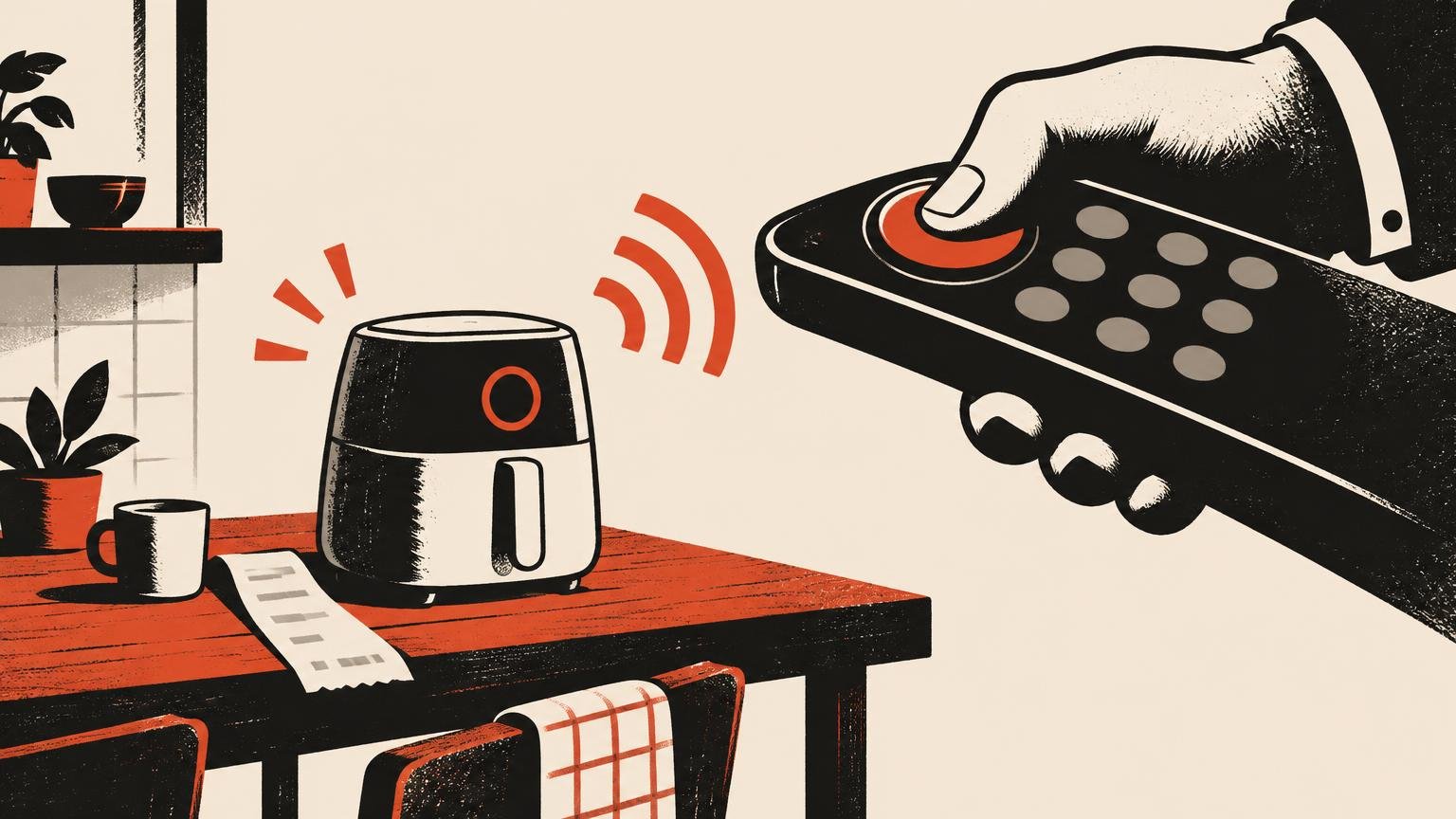
If you are comparing smart device ownership subscriptions account requirements, do not stop at the price of the box. Ask who controls the features after you pay. A connected device may depend on the manufacturer’s account system, app, servers, software updates, or recurring plan. You possess the hardware, but the company may retain the practical power to activate, change, restrict, or discontinue much of what made it worth buying.
That does not make every account or subscription abusive. Cloud storage, professional monitoring, and remote access have continuing operating costs. The problem begins when a company blurs the boundary between the product you are buying and the service you are renting—or declines to say how long either one will work.
The honest sales pitch should separate three things: what the physical product can do by itself, what requires an ongoing free service, and what requires ongoing payment. If those layers are buried in support pages or revealed only after setup, the sticker price is doing costume work.
A practical test for smart device ownership, subscriptions, and account requirements
Ownership is not one yes-or-no condition. A useful evaluation looks at five forms of control: initial operation, account dependency, subscription dependency, post-sale changes, and end-of-service consequences.
- Out-of-box operation: Can you perform the device’s central function without an internet connection, vendor app, or cloud server?
- Account dependency: Is an account needed only for setup, or also for ordinary operation, recovery, household access, resale, and factory reset?
- Subscription dependency: Which features are included with the hardware, and which stop when a trial or paid plan ends?
- Post-sale control: Can an app redesign or software update remove, rearrange, or impair functions you relied on when buying?
- Support and shutdown: Does the manufacturer state how long it will provide security updates, app compatibility, and cloud service—and what happens afterward?
A device can fare well on one part of this test and badly on another. A camera might provide a live view without a paid plan but require a subscription to preserve recordings. A light may retain a physical switch while losing remote scheduling. The question is not simply whether the product works offline. It is whether the functions that justified your purchase remain under your control.
An account requirement puts permission between you and the hardware
Google’s setup instructions say a Google Account is required to set up a Google smart speaker or display. That is an account dependency, although it does not by itself prove that every function requires continuous cloud access or payment.
Still, an account adds another gatekeeper. Access can now depend on credentials, recovery procedures, app compatibility, company policies, and the continued operation of the account platform. It also complicates transfer. Selling, gifting, inheriting, or leaving a smart device with a home may require the previous owner to remove access and reset the product.
The FTC advises buyers and sellers of smart homes to reset connected devices and change or remove account access during a transfer. That is good security advice, but it exposes an ownership weakness: handing over the object may not hand over control. A buyer can own the thermostat on the wall while the seller’s account still holds the digital keys.
Before buying, find out whether account deletion, suspension, or loss of access disables setup, remote controls, notifications, automation, or recovery. Check whether multiple household members can have independent access. For equipment attached to a home, ask whether a future owner can activate it without the original purchaser’s cooperation.
A subscription can turn the purchase price into a down payment
Ring provides a useful example of the distinction between hardware and service. Ring says its products use home Wi-Fi, a mobile device, and the Ring app for setup and use. Basic live video and real-time doorbell notifications do not require a subscription, while recording, reviewing, and sharing video are tied to eligible subscription plans.
That distinction matters. The camera does not necessarily become useless without a plan, but its value changes substantially if you expected to review an incident after it happened. A real-time alert tells you someone was at the door. A saved recording may tell you who it was after you finish the meeting that prevented you from checking the alert.
Ring’s plan materials describe recurring subscriptions that renew until canceled, subject to the company’s current plans, prices, and terms. Buyers should therefore treat the plan as part of the long-term cost rather than an optional footnote.
Do the arithmetic for the period you expect to keep the device. Multiply the current monthly or annual charge by three, five, and seven years, then include required hubs, storage, monitoring, or higher tiers. Do not assume today’s price or feature bundle is permanent. Record the plan offered when you buy and save the description of which functions are included.
A recurring charge can be fair when it pays for a clearly defined continuing service. What is not fair is presenting a service-dependent feature as though it belongs permanently to the hardware, then allowing the customer to discover the meter later.
A service shutdown reveals who had the real power
Nest Secure shows what cloud dependency looks like at the end of the road. Google says support ended on April 8, 2024. The system stopped connecting to cloud services and no longer worked through the Nest app, eliminating internet connectivity, app-based status checks, controls, and alarm notifications. Owners kept the physical equipment. They did not keep the connected system they originally used.
Google also warned that Nest Secure would receive no further software or security updates and could degrade unpredictably if operated offline. It offered an eligible group of owners a no-cost Nest Connect where Nest × Yale locks needed a replacement Wi-Fi bridge. The transition measure deserves mention, but it does not change the central lesson: a manufacturer can end the service layer while the customer is still holding the hardware.
This is why “works without a subscription” is not enough. A device may have no monthly fee and still depend on a free cloud service that can later disappear. Free is a price, not a longevity commitment.
Software can reduce value without a formal shutdown
The manufacturer does not need to discontinue a product to weaken practical ownership. In a 2024 securities filing, Sonos acknowledged that customers and partners experienced missing features, setup problems, and general unreliability after its May 2024 app and operating-system redesign. The company said it would prioritize software updates.
That episode illustrates a separate risk: hardware can remain supported and powered on while a required software layer becomes less capable or reliable. If setup, grouping, configuration, or playback controls depend on the company’s app, an app failure is a product failure from the customer’s perspective. “The speaker itself still works” is cold comfort when the prescribed controls do not.
Connected-product makers need room to fix security flaws and improve software. But remote update authority also gives them the ability to change a purchased product after the sale. Responsible ownership terms should explain which functions may change, whether updates can be delayed, what local controls remain, and how customers will be treated when a major redesign removes expected capabilities.
The missing support date is part of the price
Most buyers cannot assess longevity if the manufacturer will not publish a support period. In November 2024, FTC staff reported that 161 of 184 connected consumer products reviewed did not prominently disclose on their websites how long software updates would be provided. Basic searches failed to locate that information for 124 products. The FTC’s connected-product update survey warned that losing updates can expose products to security problems, eliminate smart functions, or stop them from working.
The absence of a published date shifts risk to the customer. You are asked to pay today while the seller keeps the useful-life calendar private. A one-year-old device and a five-year-old device can look identical on a shelf even if their remaining software support is very different.
Ask separate questions because “support” is a foggy word. How long will the company provide security patches? How long will its app support your phone’s operating system? How long will cloud services remain available? How long will customer service and replacement parts exist? A promise covering one category does not necessarily cover the others.
Matter and local control can reduce risk, not erase it
Interoperability can give buyers more options. The Connectivity Standards Alliance says Matter supports local connectivity and multi-admin operation, allowing compatible devices to connect with more than one app, platform, or control point. The Alliance’s Matter FAQ also explains that remote control of Matter-only devices requires an internet-connected controller in the home and that manufacturers may keep their own apps for advanced or differentiated features.
In plain English, a Matter logo is not a force field against shutdowns. It may preserve basic controls through another compatible platform, but it does not guarantee that every advanced feature works locally or survives the manufacturer’s departure. Check the particular function you care about: lock codes, camera history, energy reports, scenes, automations, alerts, or remote administration.
Favor devices with useful physical controls, local network operation, local storage, documented export options, and interoperable protocols. A manual key, keypad, switch, or on-device schedule can look old-fashioned right up until the server is unavailable. Then it looks like competence.
What to check before buying—and preserve afterward
Start with the central function, not the longest feature list. Decide what the product absolutely must continue doing. Then verify what that function depends on.
- Read the setup guide before purchasing. Identify every required account, app, hub, internet connection, and compatible phone platform.
- Separate included hardware functions from free cloud features, trials, and paid-plan features.
- Calculate recurring costs across the realistic ownership period, not merely the first promotional year.
- Look for specific commitments covering security updates, app compatibility, cloud availability, and end-of-service treatment.
- Check whether local controls, local storage, data export, and manual overrides remain available when internet or account access fails.
- Verify how the device is reset, transferred, sold, inherited, or removed from a home. Keep those instructions with the receipt.
- Save the product page, plan description, warranty, support promise, and checkout disclosures as they appeared when you bought.
- For Matter or other interoperability claims, confirm which important functions work through another controller rather than assuming the entire product is portable.
If a post-sale change removes a promised feature, build a clean record. Save dated screenshots, receipts, advertisements, emails, error messages, and the earlier feature description. Contact the company with a specific requested remedy: restoration, migration assistance, replacement, prorated refund, or cancellation without penalty. If the response fails, consider the payment provider’s dispute process, applicable warranty rights, and a complaint to the relevant consumer-protection agency. Available remedies and deadlines depend on the purchase terms and jurisdiction.
Ownership needs a clearer label
Companies should disclose four things at the point of sale: what the buyer owns outright, what remains dependent on a free service, what requires recurring payment, and how long each software-supported layer is expected to remain available. They should also explain what functions survive a shutdown and what remedy follows if a central advertised function disappears.
A smart device can deliver real convenience. It can also smuggle a revocable service relationship into something that looks like an ordinary durable purchase. The customer should not need detective work to tell the difference.
Before paying, imagine the company’s app is gone, its servers are offline, and your subscription has ended. Whatever useful function remains is the part you most clearly control. Everything else deserves a support commitment, a transparent price, and an exit plan.
References
- Matter FAQs | Frequently Asked Questions – CSA-IOT
- Set up your Google smart speaker or display – Android phone & tablet – Google Home and Nest Help
- Buying or selling a “smart” home? Read this. | Consumer Advice
- General Information About Ring Products and Services
- ring.com
- ring.com
- Support for Nest Secure has ended – Google Nest Help
- 0001314727-24-000026
- Smart Products Surveyed Fail to Provide Consumers with Information on How Long Companies will Provide Software Updates | Federal Trade Commission