
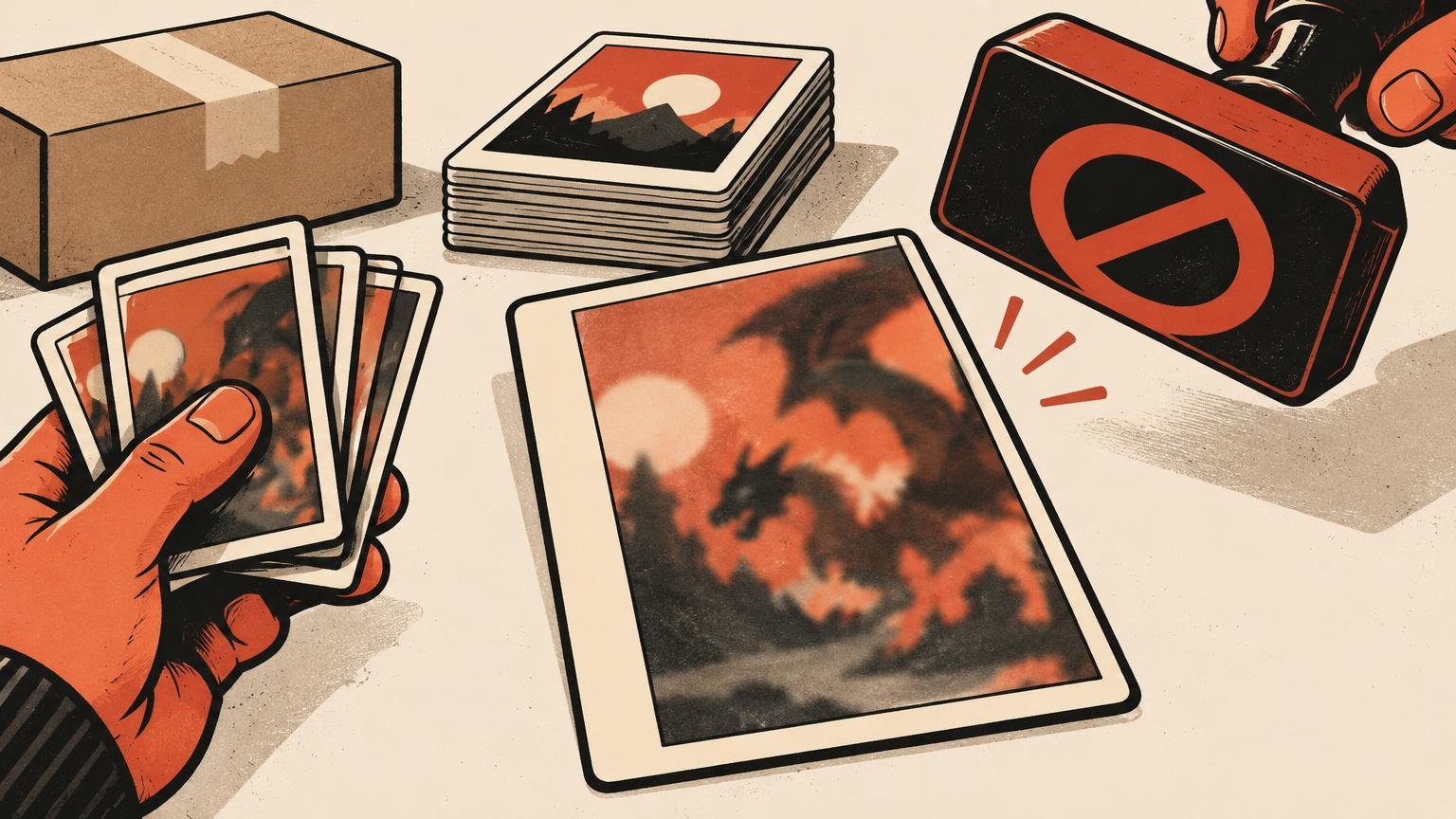
My verdict is simple: I would not recommend PrintingProxies.com based on this order. I bought 100 cards using images from the company’s own library. The delivered order included blurry cards and badly off-center cuts, and when I sought a fix, the company refused to provide one.
That is the core of this PrintingProxies.com review. I am not claiming every card had both defects, because I did not document an exact affected-card count. I am saying the quality problems across the order were obvious enough to make the purchase unacceptable—and the service response made a disappointing product worse.
What I ordered—and what I reasonably expected
This was a 100-card order intended for casual play. I selected the card visuals from PrintingProxies.com’s own image library rather than uploading personal files. The basic expectation was not luxury craftsmanship or counterfeit collectibles. It was far more modest: readable images printed on competently cut cards.
“They’re only proxies” is not a meaningful defense for avoidable production problems. A casual-play card still has a job. Players need to recognize it, read it and handle it without the borders looking as though the cutting target wandered off during production. Calling something a proxy changes its purpose; it does not erase the seller’s obligation to deliver a respectable print job.
Two separate quality problems spoiled the order
The card images looked blurry
Some of the delivered cards looked blurry. My immediate impression was that something had gone wrong with the printer, but that is an impression—not a confirmed technical diagnosis. Blur can originate with a source image, image processing or production. I did not inspect the original library files or run a technical analysis capable of isolating the cause.
The cause matters to the company’s quality-control process, but it does not rescue the result for the customer. I ordered printed cards, not an investigation into which stage of production failed. The finished product was visibly disappointing. If an image cannot produce an acceptable card, the seller should catch that problem before shipping or make the risk unmistakable before purchase.
The cuts were badly off-center
The second problem was centering. The cuts left card faces badly off-center. I am not alleging angled cuts, incorrect card dimensions, mismatched corners or any other defect that I did not observe and document. This complaint is specifically about poor centering.
Centering is not decorative trivia. It is one of the most basic signs that a printed card was cut competently. A border that is visibly much heavier on one side makes the whole product look cheap and careless. The proxy label does not turn a bad cut into a good value.
Why PrintingProxies.com’s own image library matters
The images did not come from low-resolution files sitting on my computer. I chose them from the seller’s own library. That does not prove every library file was technically excellent, and I cannot establish what quality label or warning appeared for each selection during this undated purchase. It does, however, raise a straightforward question: what quality control does the company apply to the visuals it offers and the finished cards it ships?
PrintingProxies.com’s current card-printing page tells customers to select the best or sharpest visual and displays image-quality categories. It describes an “Unknown” category as not guaranteed. Its current ordering guide also discusses a blurry-visual warning during card selection. Those present-day pages show that image quality is a known issue within the ordering system. They do not establish which warning, if any, appeared when I placed this order.
A warning can fairly allocate risk when it is timely, specific and visible. It should not become a magic phrase that excuses every poor result after the box leaves the building. When a seller supplies the image choices, processes the files, prints the cards and ships the order, it controls most of the pipeline. Dumping the entire quality risk onto the customer would make “quality control” little more than a dropdown menu.
The refusal to fix the order completed the failure
I sought a fix and PrintingProxies.com refused. I cannot supply the company’s exact wording, its stated reason, the response time or the precise remedy discussed, so I will not decorate the dispute with an invented support transcript. The supported outcome is stark enough: I reported a problem, and the company did not correct it.
The company’s currently indexed refund language says its proxies are custom-made and that it does not accept returns or refunds unless there is a severe defect on its side. The same page says manually selected proxies will not be reimbursed or exchanged for blur and warns that variations in color, size and shape can occur. A separate quality-related passage published on the company’s Privacy Policy page discusses blurry database cards and excludes exchanges for blur, color differences or a small variation in cut.
Those current pages do not prove which terms governed this undated order. They also do not establish whether these badly off-center cuts would meet the company’s threshold for a severe defect. More troublingly, the retrieved policy passages are not fully consistent in how they describe image-quality frequency, remedies and related conditions. Customers should not have to assemble the rules from mismatched pages and then guess how bad a defect must become before support takes it seriously.
Cheap or casual does not mean consequence-free
No price was supplied for this account, so there is no honest per-card calculation to perform. The value judgment does not require one. A product is not a bargain merely because it occupies a lower-stakes corner of the hobby. If the images look blurry, the cuts look badly off-center and the seller will not fix the result, the customer has paid for frustration in card form.
Support is part of the product’s value. Printing defects can happen. The revealing moment comes afterward: does the seller inspect the complaint, explain the applicable standard and offer a proportionate remedy when the result falls short? Here, the reported answer was no. That refusal turned a disappointing batch into a seller I would avoid.
Protect your evidence if a card order goes wrong
Keep the order confirmation, product-page language, checkout warnings, photographs and complete support correspondence. Photograph the affected cards in clear light and preserve the packaging. State the defect plainly, identify the outcome you want and keep a dated record of every response.
The Federal Trade Commission’s guidance for resolving problems with a business similarly recommends collecting purchase records, clearly stating the problem and requested resolution, and keeping copies of communications. It also helps to separate a discretionary return from a defect complaint; our guide to what a return policy actually promises explains why that distinction matters.
My PrintingProxies.com review verdict
I cannot generalize from one purchase to every PrintingProxies.com order. I can judge the order I received: 100 cards selected from the seller’s library, with blurry results and badly off-center cuts among them, followed by a refusal to fix the problem. That is garbage quality paired with an unacceptable service outcome.
If you are comparing sources for casual-play MTG proxies, inspect their image rules, defect policy and remedy process before ordering a large batch. Based on this experience, PrintingProxies.com does not get my recommendation. Casual play lowers the stakes of the game; it does not lower the minimum standard for printing a card and standing behind the result.
Frequently Asked Questions
What problems were reported with the PrintingProxies.com order?
The buyer reports that some cards were blurry, some were badly off-center, and the company did not correct the order after the buyer sought a fix.
How many of the 100 cards were defective?
The exact number was not documented, so the account does not establish how many cards were blurry, off-center, or affected by both problems.
Does selecting images from the seller’s library guarantee sharp cards?
No. PrintingProxies.com currently uses image-quality categories, describes its “Unknown” category as not guaranteed, and discusses a blurry-visual warning during selection. Those current pages do not establish what the buyer saw when placing this undated order.
What does the current refund policy say about blurry cards?
Currently indexed language says returns or refunds are generally limited to severe defects on the company’s side and excludes reimbursement or exchange for blur on manually selected proxies. It is unknown whether those terms governed this order.
What evidence should a customer preserve after receiving defective cards?
Keep the order confirmation, applicable product and policy language, checkout warnings, clear photographs, packaging, and complete support correspondence. The FTC also recommends collecting purchase records, stating the problem and desired resolution clearly, and retaining copies of communications.