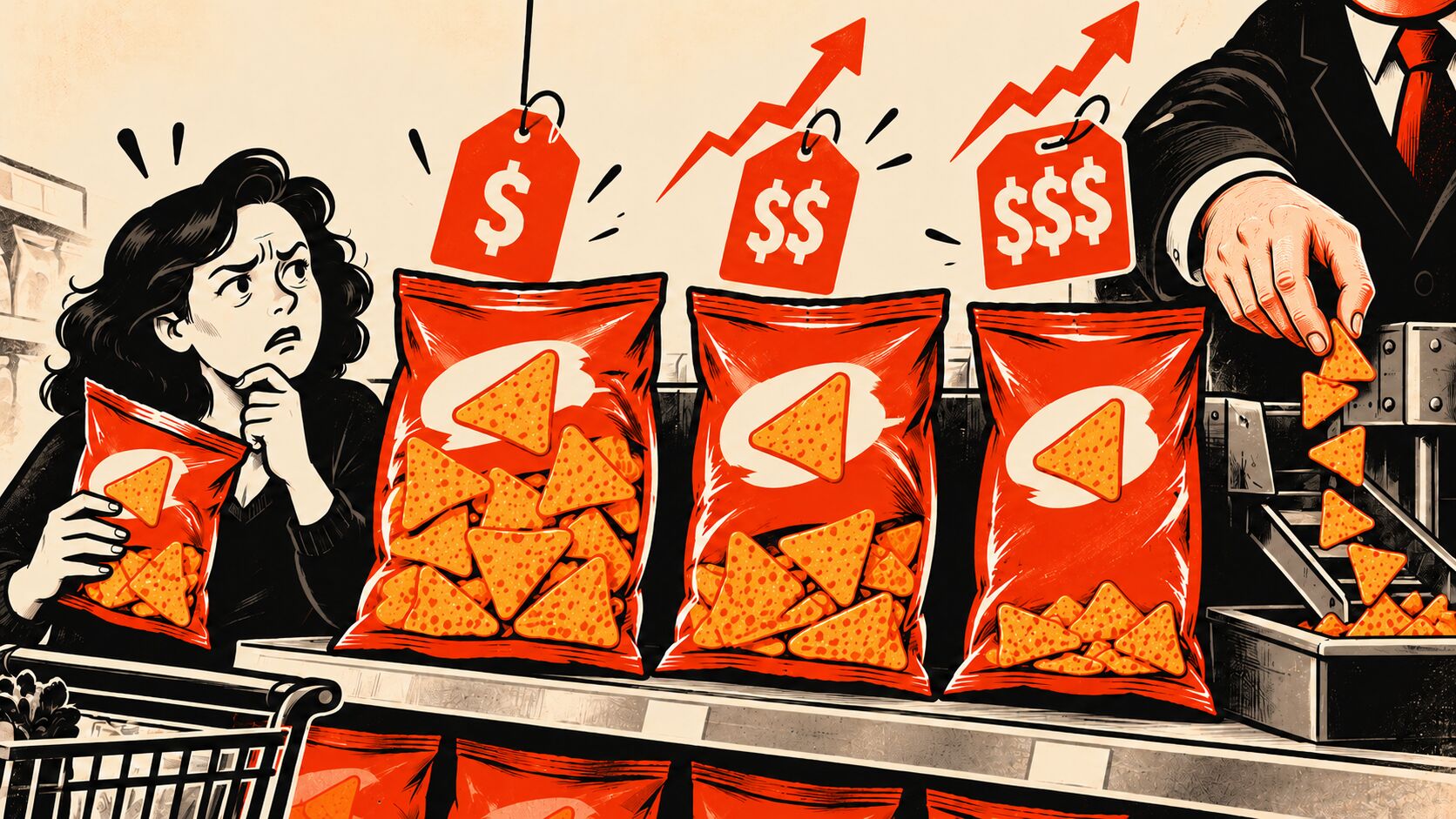
In September 2016, Frito-Lay’s then-president and chief operating officer, Vivek Sankaran, explained to investors how the snack company extracted additional revenue from new products. His description was remarkably candid: “The price point may be the same, but there’s less ounces in the bag.”
That was a decade before PepsiCo began advertising price reductions on Doritos and Lay’s to persuade irritated shoppers to come back. And it was years before COVID became the industry’s favorite inflation excuse.
The company had a name for the broader financial discipline: Price Pack Architecture, or PPA. Inside the business, according to marketing employees interviewed by RippedMeOff about practices spanning 2016 through 2026, a particularly aggressive application became known as “price up, weight out.” Raise prices, reduce weight, or stagger both changes across years. Small adjustments compounded into substantially higher prices per ounce.
Price Pack Architecture Wasn’t Just a One-Time Price Increase
Price Pack Architecture is a real consumer-products management tool. It sets the relationship between package sizes, price points, promotions, and sales channels. Used responsibly, it can offer cheaper entry sizes and family-value packages.
But it can also become an elegant name for extracting more money from people who think they’re buying approximately the same thing they bought last month.
Employees interviewed by RippedMeOff describe Frito-Lay deliberately staggering price and weight changes across brands and packages. The changes accumulated across planning cycles. They identify Eric Otto, who held Frito-Lay net revenue management roles during the period, as a central figure in building and advancing the approach.
The interviews concern Frito-Lay snacks, not beverages. Public filings don’t identify who approved each package change.
What “Price Up, Weight Out” Does to the Customer
A smaller package can raise the effective price without changing the number on the shelf.
Consider the documented reduction of a standard Doritos bag from 9.75 ounces to 9.25 ounces. That’s about 5.1% less product. At an unchanged shelf price, it makes each ounce about 5.4% more expensive. Combine that weight reduction with a hypothetical 10% shelf-price increase and the price per ounce jumps about 16%.
The math is simple. The presentation is the trick. A shopper sees a familiar brand, a familiar-looking bag, and perhaps a price that has only moved slightly. What they don’t necessarily see is the cumulative change in value.
Accurate weight labels don’t make the tactic respectful. They just assign shoppers homework to discover the lost value.
Frito-Lay Was Talking About This Before COVID
Sankaran’s 2016 investor remarks are especially revealing because he was discussing financial performance, not apologizing for an emergency. He explained how innovation, package mix, and retail-specific revenue management helped Frito-Lay improve price realization. His smaller-ounce example concerned new products, not proof that every existing Doritos bag was being reduced in 2016.
The employee interviews add the internal story: a recurring approach to price and weight changes that predated the pandemic. Staff described objections from the brand and marketing-finance side, where the priority was to build long-term loyalty rather than maximize the immediate financial yield from a package.
The early years fall under Indra Nooyi’s tenure; Ramon Laguarta succeeded her in October 2018. Interviewees criticized both the early direction and Laguarta’s slow response once consumer resistance became obvious.
COVID Turned a Pricing Machine Into a Revenue Rocket
There were legitimate cost pressures during the pandemic. Ingredients, packaging, labor, and freight became more expensive. But temporary cost inflation cannot explain away an already-established revenue-management philosophy.
PepsiCo’s own numbers show how hard it leaned on pricing. In 2022, Frito-Lay North America reported 17% organic revenue growth, with effective net pricing accounting for essentially all of it and organic volume contributing nothing. In 2023, effective net pricing added another 10 percentage points, while volume contributed approximately negative one point.
That’s the corporate equivalent of taking a victory lap while the customer base is beginning to drift away. Revenue went up, not because shoppers were buying substantially more chips, but because PepsiCo was collecting more from the business it already had.
By 2024, Frito-Lay’s unit volume was down 2.5%, net revenue declined approximately 1%, and operating profit fell about 7%. The apparent pricing superpower was running into a very ordinary consumer response: people stopped buying as much.
The Warning Was About Brand Equity, Not Spreadsheet Skills
Marketing employees interviewed by RippedMeOff say the conflict was apparent internally. Revenue-management calculations could make a smaller package and higher price look attractive in the next financial period. Brand and marketing finance had to consider what repeated disappointments did to household loyalty, repeat purchases, and the perceived fairness of the brand.
Interviewees identified Jackie Roney among the leaders who opposed the long-term direction of the PPA approach. The internal personnel conflict deserves its own investigation.
The fundamental criticism is straightforward. A model that measures the profit from taking value out of a package but undervalues the cost of driving customers to competitors is not measuring the whole business. It’s measuring the convenient part.
Retailers and Consumers Eventually Sent the Bill Back
Bloomberg reported in April 2026 that Doritos prices at Walmart had risen nearly 50% since 2021, according to consumer-spending data. Some Frito-Lay bags cost more than $7. Walmart had warned PepsiCo for over a year that prices were too high and eventually reduced Frito-Lay shelf space in favor of competitors and cheaper products.
Only in February 2026 did PepsiCo announce reductions of up to nearly 15% on selected snacks. Its new pitch was almost comical: same size, lower price.
The company now says it must improve everyday affordability and invest in advertising and consumer value. Those initiatives require money, and restoring volume at lower effective prices can weaken margins. In the third quarter of 2026, the broader PepsiCo Foods North America segment reported a 12% decline in core constant-currency operating profit. That measure includes Quaker as well as Frito-Lay and reflects more than pricing alone, but it underscores the incomplete recovery.
An Elaborate Pricing Model Cannot Replace Respect for Customers
Frito-Lay had decades of marketing, product development, and consumer trust behind Doritos, Lay’s, Cheetos, and Tostitos. That loyalty was an asset worth protecting. Instead, its pricing organization spent years testing how far the company could push shoppers before they walked away.
Extracting margin today while spending tomorrow’s profits reacquiring those customers isn’t sophisticated. PPA jargon doesn’t change the economics.
Price up, weight out wasn’t a substitute for building a better business. It was a way to collect more from an existing one. And PepsiCo is now paying to relearn the difference.
Frito-Lay Shrinkflation and Price Pack Architecture FAQs
What is Price Pack Architecture at Frito-Lay?
Price Pack Architecture is the planning of package sizes, shelf-price points, promotions, and channel-specific offerings. It can improve consumer choice, but Frito-Lay employees interviewed by RippedMeOff say it was also used to support recurring price increases and weight reductions.
How much smaller did a standard Doritos bag get?
A widely documented reduction took a Doritos bag from 9.75 to 9.25 ounces, about 5.1% less product. If the shelf price remained unchanged, the effective price per ounce rose roughly 5.4%.
Did Frito-Lay start shrinking bags because of COVID?
No. Frito-Lay’s president discussed selling fewer ounces at the same price in a 2016 investor presentation, years before COVID. Marketing employees interviewed by RippedMeOff also describe a staggered pre-pandemic pricing and weight-reduction strategy.
Why did PepsiCo eventually lower Doritos prices?
Consumers reduced purchases, cheaper alternatives gained ground, and retailers challenged Frito-Lay’s pricing. PepsiCo announced price cuts of up to nearly 15% on selected snack products in February 2026 to improve affordability and demand.
References
- PepsiCo / Thomson Reuters, Barclays Global Consumer Staples Conference, September 7, 2016
- U.S. Senate hearing record on shrinkflation and the Doritos 9.75-to-9.25-ounce change
- PepsiCo 2022 Form 10-K
- PepsiCo 2023 full-year earnings release
- PepsiCo 2024 full-year earnings release
- Bloomberg, April 7, 2026: Doritos at $7 a Bag Ended Up Costing PepsiCo Billions
- PepsiCo, February 3, 2026: Snack price reductions
- PepsiCo third-quarter 2026 results