
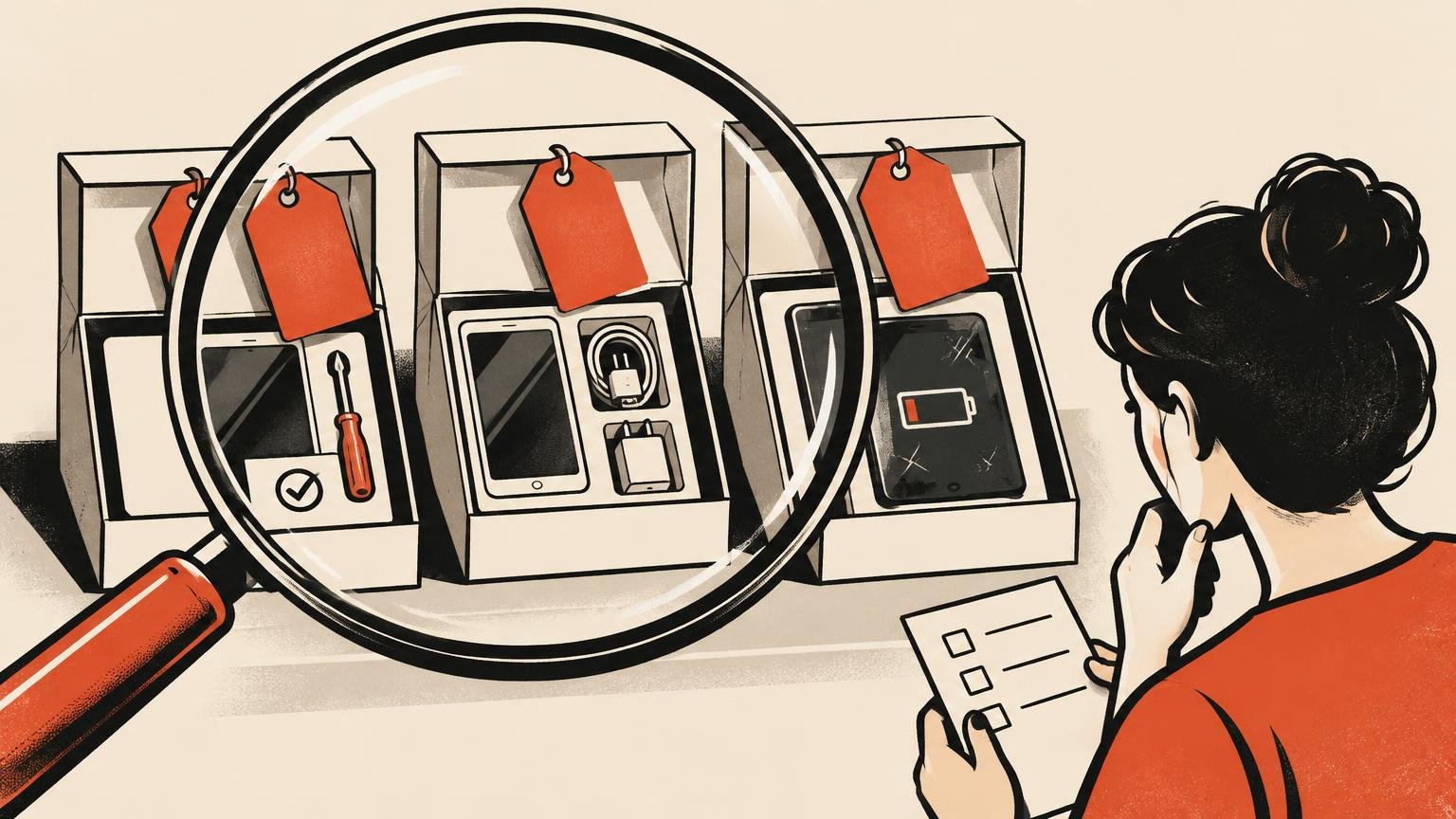
The safest approach to refurbished vs open box vs used buying is to ignore any assumed hierarchy and inspect the written promise attached to the individual item. A “refurbished” device with vague testing and a mystery warranty can be a worse bet than a plainly described used device with detailed photographs, documented battery health and a generous return window.
Condition labels are shortcuts, not guarantees. Before paying, establish who inspected the item, what was tested or replaced, what comes in the box, how returns work and who must fix the problem if it fails. If the seller cannot answer those questions in writing, the attractive label is doing more work than the actual offer.
There is no universal refurbished, open-box or used ranking
Retailers, manufacturers and marketplaces define condition terms through their own programs and category rules. Apple’s Certified Refurbished program, eBay’s condition categories and Best Buy’s open-box system make different promises. Those definitions tell you about their respective programs; they do not establish an industry-wide standard.
That kills the tidy assumption that refurbished always beats open box, which always beats used. A particular certified program may offer extensive testing and warranty protection. Another seller may use “seller refurbished” for little more than cleaning, resetting and repackaging. An open-box item might be an unwanted return, a store display or something else allowed by the seller’s definition. “Used” confirms prior use but often leaves the important details to the listing.
Treat the label as the beginning of the investigation. The listing, condition notes, photographs, return policy and warranty document are where the seller’s obligations become concrete.
What refurbished can mean
Refurbished should describe a process, but the word alone does not tell you who performed it or how thorough that process was. Ask whether the manufacturer, an authorized provider, the marketplace seller or an unidentified third party handled the work. Then ask what “refurbishment” actually included: functional testing, diagnostics, cleaning, repair, replacement parts, cosmetic grading or merely a factory reset.
Apple provides an example of a program with specific written commitments. The company says its Certified Refurbished products undergo full functional testing, cleaning and inspection, use genuine Apple replacement parts when needed and include a one-year limited warranty. It also says refurbished iOS devices receive a new battery and outer shell, while devices come with accessories, cables and operating systems. Those are Apple program terms, not promises that attach to every product advertised as refurbished.
eBay illustrates why shoppers must also consider the marketplace and product category. In applicable electronics categories, it distinguishes Certified Refurbished items from Excellent, Very Good and Good Refurbished grades. Each category carries its own description. Those labels are eBay’s category definitions, not universal measurements that can be carried over to another retailer.
The practical question is not “Is it refurbished?” It is “Which documented refurbishment process applies to this exact listing, and who stands behind it?”
What open box can mean
Open box sounds reassuringly close to new. Sometimes it is. The box may have been opened and the product returned without meaningful use. But the term can also cover a display unit or another item whose history and condition depend on the retailer’s rules.
Best Buy says its open-box products may be customer returns or store displays and that each is tested or inspected for proper working order and physical appearance. It also warns that condition and manufacturer-warranty coverage vary by product. That combination matters: an inspection is useful, but it does not answer which functions were tested, how heavily a display item ran or whether the original manufacturer will handle a later failure.
For relevant eBay categories, “Open box” means an item in excellent, new condition with no wear. Packaging or protective wrapping may be missing, original accessories are included, and the item may be a factory second. Again, that is a marketplace definition for applicable categories—not a rule governing every seller that uses the phrase.
Check the specific condition notes for scratches, missing packaging, signs of installation and display use. Confirm whether chargers, stands, mounting hardware, adapters and proprietary cables are included. A missing five-dollar cable is annoying. A missing proprietary component that costs much more—or is difficult to obtain—can erase the discount.
What used tells you—and what it does not
Used is often the most honest label because it makes the item’s history explicit. It still does not tell you how long the product was used, whether it was repaired, how much battery capacity remains or whether every function works.
In applicable eBay categories, a used item has been previously used, may have cosmetic wear and is described as fully operational and functioning as intended. eBay directs buyers to the listing for complete condition details and imperfections. The final sentence is the important one: the broad category cannot substitute for item-specific disclosure.
A well-documented used listing can offer less uncertainty than a vaguely refurbished one. Clear photographs, a serial number where safe and appropriate, diagnostic results, repair records and an uncomplicated return policy provide evidence. A polished condition badge does not.
Compare the written promise, not the label
| Question | What a useful answer includes | Why it matters |
|---|---|---|
| Who is accountable? | The legal seller plus the party handling returns and warranty claims | A marketplace, seller and manufacturer may have different responsibilities |
| What was checked? | Named functions, diagnostics or an inspection standard | “Tested” can otherwise mean almost anything |
| What was repaired? | Replaced components and, where relevant, the type or source of parts | Repair quality and future support may depend on the work performed |
| What is included? | A complete itemized list of accessories and missing pieces | Replacement costs can wipe out the apparent saving |
| What condition is documented? | Listing-specific photographs and written cosmetic notes | A generic grade may conceal damage important to you |
| What happens if it fails? | Return deadline, fees, shipping responsibility and written warranty process | The real value of protection depends on whether you can use it |
Read the return policy as a procedure, not a slogan. Identify when the clock starts, whether you need authorization, who pays return shipping and whether opened, activated or registered products face special restrictions. Check for restocking fees and requirements to return every accessory or piece of packaging.
Then separate the warranty from the return policy. A return window lets you reject the purchase under stated conditions. A warranty addresses covered defects for a stated period. A separately sold service contract is another product, not simply a longer name for the warranty included with the item.
A pre-purchase checklist for refurbished vs open box vs used buying
- Identify the actual seller, not just the marketplace or website hosting the listing.
- Read the seller’s current definition of the exact condition grade for that product category.
- Ask whether the item was inspected, functionally tested, repaired, cleaned or only reset.
- Request the testing scope and any available diagnostic results.
- Ask which components were replaced and whether the replacement parts are identified.
- Compare the included accessories against the manufacturer’s original package contents.
- Check listing-specific photographs rather than relying on generic product images.
- Read the return deadline, fee, shipping and accessory requirements before ordering.
- Identify the warranty issuer, duration, exclusions and claim process.
- Save the listing, condition notes, photographs, seller messages, return terms and warranty document.
- Keep the receipt and payment record after the item arrives.
Save the evidence before checkout because listings can change or disappear. If a seller promises a new battery, original charger or fee-free return in a message, keep that exchange with the order record. A promise you can produce is far more useful than one you vaguely remember.
Battery-powered and connected devices need extra questions
Battery condition can turn a bargain into an immediate repair bill. Where relevant, ask for documented maximum capacity, cycle count, replacement status and any separate battery-warranty terms. “Battery tested” is incomplete unless the seller explains what passed. A battery may power on while delivering much less useful runtime than the buyer expects.
Connected electronics create another set of risks. Confirm that the device is factory reset and free from account, activation, carrier, financing or organizational-management locks where applicable. A device can be physically present and technically functional while an old account or remote service prevents the new owner from using essential features. For more on that distinction, see how company accounts and services can limit device ownership.
During the return window, test the functions that would be expensive or disruptive to discover later: charging, ports, buttons, microphones, speakers, cameras, display, wireless connectivity and biometric sensors where fitted. This is not the moment for a leisurely unboxing. The return clock is already moving.
Read “as is,” final-sale and warranty language carefully
For U.S. purchases, the Federal Trade Commission advises consumers to read a written warranty before buying and check what it covers, how long coverage lasts, how service is obtained, and who pays costs such as shipping or labor. Its consumer guidance on warranties also distinguishes an included warranty from a separately purchased service contract.
Implied-warranty rules and a seller’s ability to disclaim coverage with clear “as is” or no-warranty language can vary by state. The FTC directs consumers seeking state-specific guidance to a lawyer or state consumer-protection office. It also recommends keeping proof of purchase and warranty documents and obtaining important promises in writing.
Do not translate “as is” into a precise legal conclusion without considering the seller, wording, jurisdiction and transaction. Translate it into a practical warning: protection may be limited, so investigate before paying and price the risk accordingly.
When to demand clarification—or walk away
Pause when a listing uses a confident condition grade but avoids specifics. Warning signs include stock photos only, conflicting descriptions, an unnamed warranty provider, no list of included accessories, unanswered battery questions, opaque repair history and return terms scattered across several pages.
One unclear detail may be fixable with a written question. Several unclear details reveal the business model: the seller wants you to accept the risk while the label supplies the confidence. Unless the discount comfortably covers that uncertainty and a possible repair, find a better-documented item.
Buy the protection behind the condition label
Refurbished, open box and used can each describe a sensible purchase. None automatically wins. The strongest listing is the one that gives you enough evidence to understand the item’s condition and a workable remedy if that description proves wrong.
Choose the offer with accountable parties, specific testing, disclosed repairs, complete accessory information and return and warranty terms that fit your tolerance for risk. If two products cost about the same, the clearer written promise is usually worth more than the shinier badge.